
Before 2,555 Marines deployed, researchers drew their blood and measured C-reactive protein, the standard gauge of inflammation. After deployment, that pre-trauma number predicted who developed PTSD symptoms. Each 10-fold step up in CRP carried 1.51 times the odds (Eraly et al., 2014).
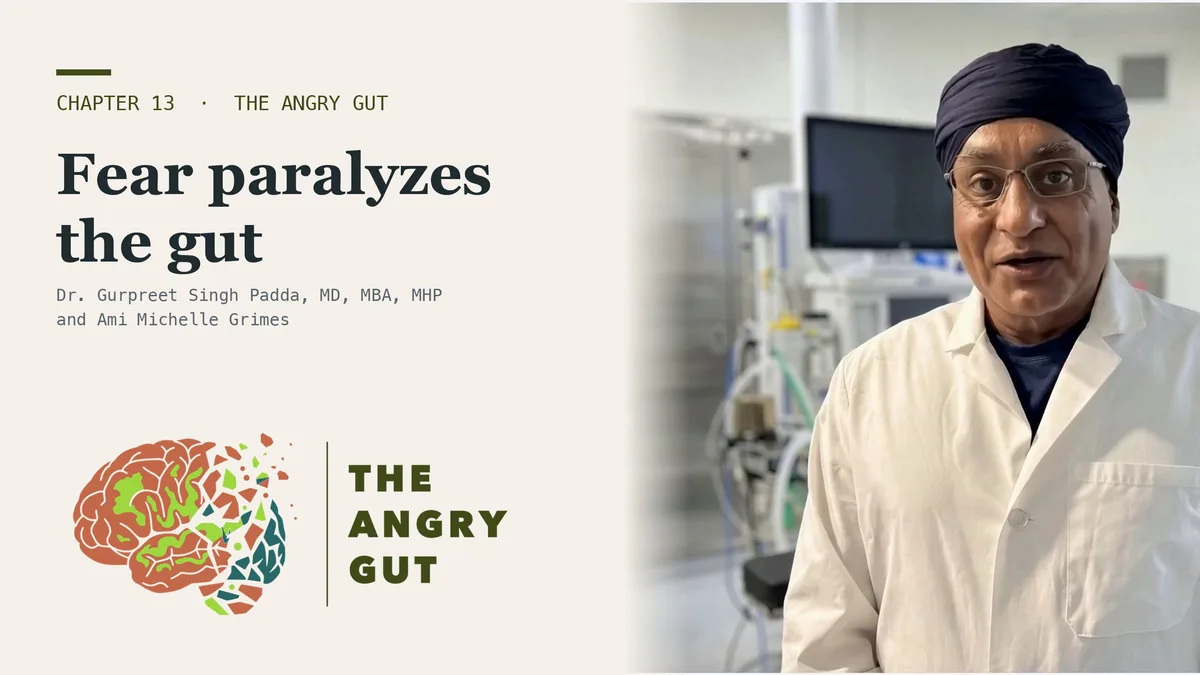
Most writing on stress and inflammation assumes one direction: something terrible happens and the body catches fire. That does happen. But the Marine data say the fire can already be lit when the trauma arrives, and an inflamed body may be the one least able to file the event. The video above, from Chapter 13 of The Angry Gut, which Dr. Gurpreet Singh Padda, MD, MBA, MHP, co-wrote with Ami Michelle Grimes, begins with a man and two specialists. This page begins with the lab slip: what inflammation markers, stool tests and permeability panels actually show after trauma, and what repairs the terrain underneath them.
A threshold, not a dose
Baseline CRP predicted whether symptoms appeared at all. It did not significantly predict how severe they became once they did; that term came in at 1.06 and missed significance (Eraly et al., 2014). Inflammation seems to lower the threshold at which a nervous system tips into post-traumatic symptoms, rather than turning up the volume afterward.
That reframes the terrain. Two biological drivers are in play: a baseline inflammatory load, often carried by metabolic disease, and a stress response that keeps signaling danger to the bowel and the immune system. The third driver is social: the circumstances that load a nervous system in the first place, from military service to a childhood nobody recorded. Among 120,572 service members, PTSD raised the risk of selected autoimmune diseases by 58%, and adding body mass index, smoking and alcohol moved the estimate by less than 1% (Bookwalter et al., 2020). With or without combat deployment, the hazard ratios were close, 1.7 and 1.5. The habits people get blamed for did not explain the risk.
How large is the fire after childhood adversity?
Childhood trauma does raise adult inflammatory markers, modestly. Across 18 studies and 16,870 people, the effect size was 0.10 for CRP, 0.08 for interleukin-6 and 0.23 for tumor necrosis factor alpha (Baumeister et al., 2016). The largest number rests on the smallest pile of evidence: 10 studies and 881 people for TNF-alpha. Body mass index did not moderate the effect.
A stratified analysis sharpens where the lift lives. Across 53 studies and 12,141 psychiatric patients, childhood maltreatment raised pro-inflammatory markers at an odds ratio of 1.186, with interleukin-6 carrying the link at 1.609. That effect did not appear in the non-psychiatric controls inside the same studies, and CRP increases were not specific to trauma (Van Den Noortgate et al., 2025). Maltreatment plus psychiatric illness looks inflammatory. Maltreatment alone, in these data, did not clearly register.
So a CRP result cannot tell you whether your childhood inflamed you. It tells you there is a fire. Finding the fuel is a separate job, and it usually leads back to metabolic load, the same reason the same injection heals one person and fails another.
What a gut microbiome test cannot see after trauma
Stool testing is where people spend money, and it is the weakest evidence in the field. In 2,004 children, overall early-life stress showed no link to diversity, genera or functional pathways after correction. Only socio-economic stress registered, explaining 0.11% of the variance in community composition (Mulder et al., 2024). That small signal ran through diet quality, fiber intake and body weight, not through CRP. The children were short on fiber, too: only 25% met the guideline, and the cohort averaged 2.7 g/MJ per day.
Grown women showed the same pattern. Among 107 of them, early adversity forecast weight and depression rather than which bacteria lived in the gut, and the path from adversity to inflammation ran through body weight. Adversity also interacted with sugar and whole-grain intake to shape inflammatory markers and the microbiome (Hantsoo et al., 2026).
The methods problem explains why the stool literature keeps contradicting itself. Match cases and controls on host variables instead of adjusting for them, and 26 sequence variants that seemed to differ in type 2 diabetes fell to zero (Vujkovic-Cvijin et al., 2020). The confounders that matter include body mass index, age, alcohol, bowel movement quality and how often people eat vegetables, whole grains and meat. A stressed gut often moves slowly, and a slow gut prints a different census. The census is not the activity, so a gut microbiome test that ignores transit and diet is largely reporting on your plate and your bowel habit.
The permeability panel that disagrees with itself
If trauma inflamed the body through a leaky gut, blood permeability markers should track symptoms. In 17 veterans, seven such markers did not follow PTSD severity, and they did not agree with one another either, with correlations between markers ranging from r of -0.31 to 0.35 (Hoisington et al., 2023). Seventeen people cannot prove an absence. But seven tests of one thing that contradict each other point to a problem upstream of sample size, and why the leaky gut test you paid for cannot see the wall is worth reading before you buy another panel.
Stress and inflammation: which way the arrow runs, and where repair starts
If the flora drove the fear, fixing the flora should fix the fear. The best test of that direction does not deliver it. In 44 adults with IBS and mild to moderate anxiety or depression, one probiotic strain improved depression scores in 14 of 22 patients against 7 of 22 on placebo and changed brain responses to negative emotional images. It did not change anxiety, IBS symptoms or the fecal microbiota profile, and several authors worked for the company that makes the strain (Pinto-Sanchez et al., 2017).
Now the other direction. In 84 patients given cognitive behavioral therapy for IBS, baseline gut features predicted who would respond, and brain network changes after treatment tracked shifts in the microbiome (Jacobs et al., 2021). No control arm, so it is a signal. Still, the talking therapy moved the flora, and that is the order we repair in.
- Safety first. A nervous system braced for threat slows digestion. Therapies aimed at that state have randomized evidence in IBS; products aimed at the flora have not shown they repair the fear.
- Fiber and food quality. In both the child and adult cohorts, the trail from adversity to the microbiome ran through diet, fiber, sugar and whole grains.
- Body weight and metabolic load. Weight carried the path from childhood adversity to inflammation in adult women. Lowering that load removes fuel, whatever lit the fire.
- Measure the terrain, not the census. An inflammation marker read alongside weight, diet and bowel habit tells you more than a species list recorded without any of them.
Do not start or stop a medication or supplement on the strength of a stool report; work every change through with your physician. The same inflamed terrain shows up in joints, the reason the gut-joint connection matters. The previous piece covered a leaking brain barrier and the waistline that predicts it, and the next follows the cells that starve when the gut ecosystem stops producing. Every study above, with its full figures and its limits, is in the Deep Dive for Chapter 13.
Frequently asked questions
Does stress cause inflammation?
Stress and inflammation feed each other in both directions. Childhood trauma is linked to modestly higher adult CRP, interleukin-6 and TNF-alpha, and in Marines, higher CRP before deployment predicted who developed PTSD symptoms afterward. The strongest lift appears when trauma meets psychiatric illness or metabolic load. See why inflammaging makes a body feel like it is failing at 50.
Can a gut microbiome test show damage from stress or trauma?
Not reliably. In 2,004 children, early-life stress barely touched the microbiome, and the small signal ran through diet, fiber and body weight. Stool consistency, diet, age and alcohol all shift results, and most trauma studies never recorded them. A test without that context mostly reports your plate and your transit time. Here is a metabolic audit that tests whether your body can heal.
Is CRP higher in people with PTSD?
Often, but the picture has limits. In Marines, CRP measured before deployment predicted whether PTSD symptoms appeared, though not how severe they became. In psychiatric patients, CRP increases were not specific to trauma. CRP is a gauge of fire, not a record of what started it. Learn what hsCRP and other inflammation markers can tell you.
Does a leaky gut blood test prove trauma affected my gut?
No. In veterans, seven blood markers of intestinal permeability did not track PTSD severity and did not agree with each other. The most widely used zonulin kit has also been shown not to detect the protein named on its label. Treat those numbers with caution before building a treatment plan on them. See the inflammation that physical therapy cannot touch.
Can probiotics fix stress-related gut symptoms?
The evidence is thin. In a small trial of adults with IBS and anxiety or depression, one probiotic strain improved depression scores but did not improve IBS symptoms or anxiety, and it did not change the gut microbiota profile. Nervous-system therapies have stronger evidence for the bowel itself. Read how anxiety shows up as a fire in the gut.
Inflamed, stressed and tired of tests that explain nothing?
We measure the terrain behind the fire, metabolic load, inflammation and the nervous system, and build a repair plan in the order the evidence supports.
Questions? Call (314) 295-3000 or text (314) 886-5902.
Sources
- Eraly, S. A., Nievergelt, C. M., Maihofer, A. X., Barkauskas, D. A., Biswas, N., Agorastos, A., O’Connor, D. T., & Baker, D. G. (2014). Assessment of plasma C-reactive protein as a biomarker of posttraumatic stress disorder risk. JAMA Psychiatry, 71(4), 423-431. https://doi.org/10.1001/jamapsychiatry.2013.4374
- Bookwalter, D. B., Roenfeldt, K. A., LeardMann, C. A., Kong, S. Y., Riddle, M. S., & Rull, R. P. (2020). Posttraumatic stress disorder and risk of selected autoimmune diseases among US military personnel. BMC Psychiatry, 20(1), 23. https://doi.org/10.1186/s12888-020-2432-9
- Baumeister, D., Akhtar, R., Ciufolini, S., Pariante, C. M., & Mondelli, V. (2016). Childhood trauma and adulthood inflammation: A meta-analysis of peripheral C-reactive protein, interleukin-6 and tumour necrosis factor-alpha. Molecular Psychiatry, 21(5), 642-649. https://doi.org/10.1038/mp.2015.67
- Van Den Noortgate, M., Morrens, M., Foiselle, M., & De Picker, L. (2025). Immune dysregulation in psychiatric disorders with and without exposure to childhood maltreatment: A transdiagnostic stratified meta-analysis. Brain, Behavior, and Immunity, 127, 193-204. https://doi.org/10.1016/j.bbi.2025.03.002
- Mulder, R. H., Kraaij, R., Schuurmans, I. K., Frances-Cuesta, C., Sanz, Y., Medina-Gomez, C., Duijts, L., Rivadeneira, F., Tiemeier, H., Jaddoe, V. W. V., Felix, J. F., & Cecil, C. A. M. (2024). Early-life stress and the gut microbiome: A comprehensive population-based investigation. Brain, Behavior, and Immunity, 118, 117-127. https://doi.org/10.1016/j.bbi.2024.02.024
- Hantsoo, L., Ford, E., Friedman, E. S., Hao, F., Patterson, A. D., Bittinger, K., Wu, G. D., Zemel, B. S., & Tanes, C. (2026). The impact of adverse childhood experiences on gut microbiota and markers of inflammation is mediated by obesity and depression. Brain, Behavior, and Immunity, 134, 106479. https://doi.org/10.1016/j.bbi.2026.106479
- Vujkovic-Cvijin, I., Sklar, J., Jiang, L., Natarajan, L., Knight, R., & Belkaid, Y. (2020). Host variables confound gut microbiota studies of human disease. Nature, 587(7834), 448-454. https://doi.org/10.1038/s41586-020-2881-9
- Hoisington, A. J., Stamper, C. E., Stearns-Yoder, K. A., Haghighi, F., Lowry, C. A., & Brenner, L. A. (2023). A cross-sectional study of correlations among blood-based biomarkers for intestinal permeability: A pilot study of United States veterans with posttraumatic stress disorder symptoms. Brain, Behavior, & Immunity – Health, 34, 100702. https://doi.org/10.1016/j.bbih.2023.100702
- Pinto-Sanchez, M. I., Hall, G. B., Ghajar, K., Nardelli, A., Bolino, C., Lau, J. T., Martin, F.-P., Cominetti, O., Welsh, C., Rieder, A., Traynor, J., Gregory, C., De Palma, G., Pigrau, M., Ford, A. C., Macri, J., Berger, B., Bergonzelli, G., Surette, M. G., … Bercik, P. (2017). Probiotic Bifidobacterium longum NCC3001 reduces depression scores and alters brain activity: a pilot study in patients with irritable bowel syndrome. Gastroenterology, 153(2), 448-459.e8. https://doi.org/10.1053/j.gastro.2017.05.003
- Jacobs, J. P., Gupta, A., Bhatt, R. R., Brawer, J., Gao, K., Tillisch, K., Lagishetty, V., Firth, R., Gudleski, G. D., Ellingson, B. M., Labus, J. S., Naliboff, B. D., Lackner, J. M., & Mayer, E. A. (2021). Cognitive behavioral therapy for irritable bowel syndrome induces bidirectional alterations in the brain-gut-microbiome axis associated with gastrointestinal symptom improvement. Microbiome, 9(1), 236. https://doi.org/10.1186/s40168-021-01188-6