
Three tests get sold as a window into the inflamed gut behind a low mood: C-reactive protein, a zonulin panel and a stool microbiome report. One, the test behind high CRP levels, is a useful research cut-off that needs context. One has been shown to detect a different protein than the one on its label. One reads a census that has rarely held up on replication.
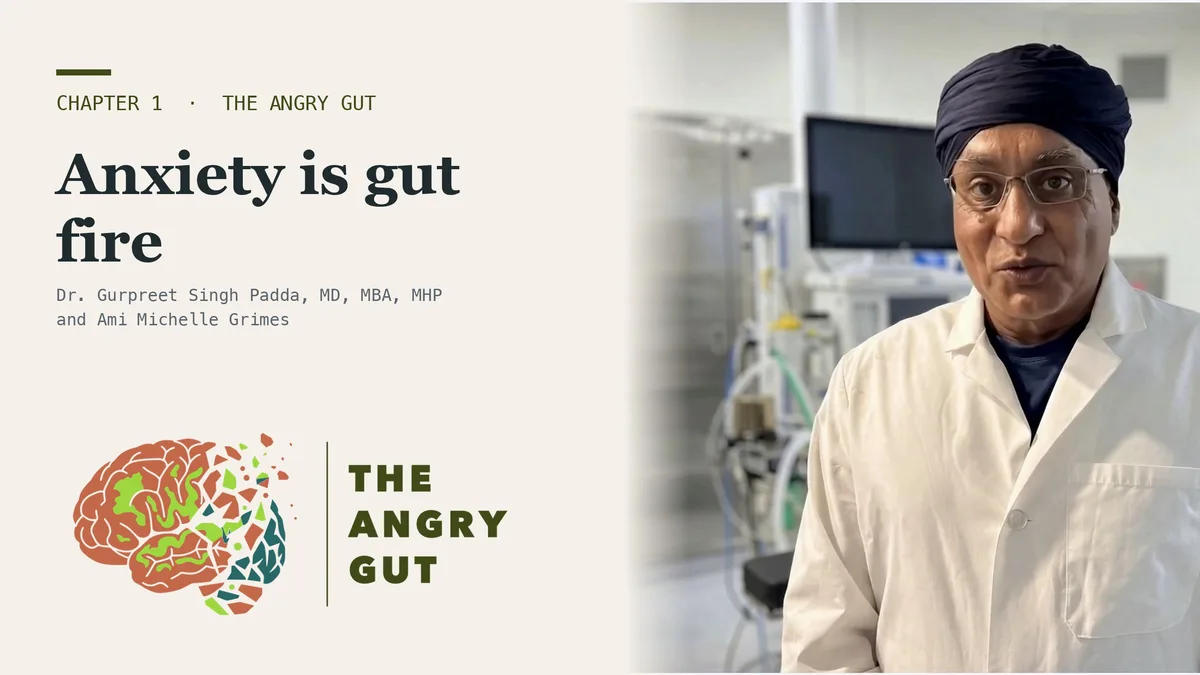
The video Your Anxiety Is a Fire in Your Gut, from Dr. Gurpreet Singh Padda, MD, MBA, MHP, argues that inflammation born in the first brain can reach the second. The question here is measurement: what high CRP levels mean for mood, what they do not mean, and what actually repairs the terrain underneath.
What high CRP levels mean for mood
Set the threshold at 1 mg/L and 58 percent of people with depression show raised CRP. At 3 mg/L, the usual line for low-grade inflammation, the share is 27 percent (Osimo et al., 2019). At the 1 mg/L line, the odds of raised CRP in depression were 1.47.
The most useful finding sits in the fine print. The share of inflamed patients was not explained by where they were recruited, antidepressant use, age, BMI or ethnicity. It is a real division inside one diagnosis, and it stays invisible until someone draws the blood.
Read the number with its limits attached. The 3 mg/L and 5 mg/L thresholds are research cut-offs on a marker that also rises with infection, injury or a hard workout. A single high value is a reason to repeat the test and look for a cause, not a diagnosis, which is how hsCRP is read alongside other inflammation biomarkers.
Why an anti-inflammatory drug only helps the inflamed
Treatment trials show the split. In the largest infliximab trial in treatment-resistant depression, three infusions over a 12-week study made no overall difference, but responders had higher baseline TNF and soluble TNF receptor levels (Raison et al., 2013). Pooled across four trials and 152 patients, infliximab still showed no significant benefit, and any gain sat with people who already carried raised inflammatory markers.
Across every anti-inflammatory agent added to an antidepressant, response was more likely, with a risk ratio of 1.76, though that rests on 341 patients (Köhler-Forsberg et al., 2019). Used alone, the pooled effect came with heterogeneity of 93 percent, meaning the trials were not measuring one thing. An average across everyone hides the subgroup a biomarker exists to find. It is the same reason one treatment heals one person and fails another.
The genetic argument that inflammation is a bystander
The strongest case against this model comes from genetics. In a Norwegian population study of 68,769 people, doubling genetically predicted CRP raised a depression symptom score by 2.43 percent, with a confidence interval that crossed zero (Bekkevold et al., 2023). A UK Biobank analysis of 89,119 people found an interleukin-6 receptor effect that was statistically real and clinically tiny, an odds ratio of 1.023.
Those studies measure a lifetime of slightly different genetic set-points in general populations scored by questionnaire. They do not measure inflammation lit by diet, fat mass, a leaking gut wall or repeated antibiotics, and they were not run in metabolically ill, high-CRP people. They rule out inflammation as the engine of depression across everyone. They do not rule out the inflamed subgroup, and a genetic study inside that group is the one that would change the argument.
Leaky gut tests and the zonulin problem
Zonulin is the marker most leaky-gut panels quote. When a widely used commercial ELISA kit was examined in 376 subjects, it did not detect the zonulin precursor named on the label and appeared to recognize properdin instead (Scheffler et al., 2018). The signal still rises in obesity and diabetes, so it tracks something biological, but the name on your report may not match the molecule in the well.
Lipopolysaccharide-binding protein, a marker of bacterial fragments reaching the blood, is more candid about its limits. In 176 adults being evaluated for sleep apnea, LBP did not differ by depression severity, yet it did track a blood measure of systemic inflammation (Gawlik-Kotelnicka et al., 2025). One marker at one time point is a weak instrument for mood. Where antibodies were measured instead, patients with major depression carried more IgM and IgA against gut bacterial endotoxin, and the panel separated them from healthy volunteers with an area under the curve of 90.1% (Maes et al., 2008).
Why a gut microbiome test cannot read your mood
Microbiome reports sell a species list, and the research behind them shrinks on replication. In a discovery cohort of 1,054 people and a replication cohort of 1,539, overall community makeup explained almost nothing in the first (R2 = 0.003) and failed outright in the second (Radjabzadeh et al., 2022). Of 24 genera linked to symptoms at first, 12 replicated. Genetic direction testing even leaned toward depression shifting one genus, Eggerthella, rather than the reverse.
Changing the census does not guarantee changing the person. In 83 healthy young women, a galacto-oligosaccharide prebiotic raised Bifidobacterium (p = 0.001) while trait anxiety did not differ from placebo (Johnstone & Cohen Kadosh, 2025). The census is not the activity. A stool test tells you who is present, not what they are doing to you.
What repairs the terrain behind an inflamed mood
Bacteria do not ship serotonin to the brain. What a fed flora does is turn up your own machinery. In cell culture, 7 of 16 bacterial metabolites raised serotonin output from chromaffin cells, among them butyrate, propionate and bile acids, and in mice colonization made existing enterochromaffin cells busier without adding new ones. The raw input for much of that is fermentable fiber.
The patients who turn out inflamed tend to carry more than a mood complaint. They bring the high fasting insulin, the widening waist and the unsettled bowel, living on a food supply built on cheap flour and sugar that strips out the fiber a flora needs. Their home life counts too: in married couples, more hostile arguments went with higher LBP. That combination is the metaflammation terrain, and it is why metabolic inflammation is worked up as one system.
Diet trials support feeding the terrain over swallowing a shortcut. In SMILES, every 10 percent rise in dietary adherence came with a 2.2-point improvement in depression scores. By contrast, a year of daily multinutrient supplements in more than a thousand overweight or obese adults did not prevent major depression (odds ratio 1.06), and the supplement-only arm had the highest incidence, at 12.5 percent (Bot et al., 2019). A pill of nutrients is not a diet.
- Has my CRP been measured, and was a high value repeated?
- What is my fasting insulin?
- If a zonulin or stool panel was run, what decision will the result change?
- For any supplement, which outcome did the trial choose first, and did that one work?
The full record, including the transplant and nerve-stimulation trials, lives in the Chapter 1 Deep Dive, the evidence companion to The Angry Gut by Dr. Padda and Ami Michelle Grimes. Start with what stomach acid does to probiotics if you missed it, and continue to what else is in the pill.
Frequently asked questions
What CRP level counts as high?
It depends on the purpose. Depression research commonly uses above 3 mg/L to define low-grade inflammation, and one infliximab trial saw benefit only above 5 mg/L. Those are research cut-offs on a marker that also rises with infection, injury or intense exercise, so a single elevated result should be repeated and explained before it is treated as a diagnosis. See what a full metabolic audit measures.
Is the zonulin test accurate for leaky gut?
Not as labeled. A widely used commercial zonulin ELISA, examined in 376 subjects, did not detect the zonulin precursor it names and appeared to recognize a different protein, properdin. Levels still rise in obesity and diabetes, so the test tracks something biological, but its result should not be read as a direct measure of gut permeability. Read what is known about the leaking gut wall.
Can a gut microbiome test diagnose depression or anxiety?
No. The same depleted and enriched bacterial groups appear across depression, bipolar disorder, schizophrenia and anxiety, and many associations shrink once alcohol intake and stool form are accounted for. A stool report lists which microbes are present, not what they are doing, and replication across large cohorts has been poor. Explore how the microbiome relates to joint inflammation.
Can inflammation cause depression?
In some people, yes. Healthy volunteers given a small dose of bacterial endotoxin develop depressed mood, and interferon, an inflammatory treatment, induced major depression in about a quarter of hepatitis C patients. Genetic studies in general populations find only small effects, which fits inflammation driving depression in an inflamed subgroup rather than in everyone. Read how the modern plate sets the brain on fire.
Does diet help inflammation-related mood symptoms?
Diet has the strongest treatment evidence here. In a randomized trial of adults with major depression, dietary support produced remission far more often than social support, and closer adherence brought larger gains. Daily nutrient supplements failed to prevent depression in a large European trial. Fiber matters because bacteria turn it into molecules that raise your own serotonin production. Learn how inflammation accelerates aging.
Measure the terrain before you treat the number
Regen.MD reads CRP, insulin and gut history together, so a single lab value becomes a question about your terrain rather than a label.
Questions? Call (314) 295-3000 or text (314) 886-5902.
Sources
- Osimo, E. F., Baxter, L. J., Lewis, G., Jones, P. B., & Khandaker, G. M. (2019). Prevalence of low-grade inflammation in depression: A systematic review and meta-analysis of CRP levels. Psychological Medicine, 49(12), 1958–1970. https://doi.org/10.1017/S0033291719001454
- Raison, C. L., Rutherford, R. E., Woolwine, B. J., Shuo, C., Schettler, P., Drake, D. F., Haroon, E., & Miller, A. H. (2013). A randomized controlled trial of the tumor necrosis factor antagonist infliximab for treatment-resistant depression: The role of baseline inflammatory biomarkers. JAMA Psychiatry, 70(1), 31–41. https://doi.org/10.1001/2013.jamapsychiatry.4
- Köhler-Forsberg, O., N Lydholm, C., Hjorthøj, C., Nordentoft, M., Mors, O., & Benros, M. E. (2019). Efficacy of anti-inflammatory treatment on major depressive disorder or depressive symptoms: Meta-analysis of clinical trials. Acta Psychiatrica Scandinavica, 139(5), 404–419. https://doi.org/10.1111/acps.13016
- Bekkevold, O.-J., Damås, J. K., Brumpton, B. M., & Åsvold, B. O. (2023). The causal role of C-reactive protein and interleukin-6 on anxiety and depression symptoms and life satisfaction: Mendelian randomisation analyses in the HUNT study. Psychological Medicine, 53(16), 7561–7568. https://doi.org/10.1017/S0033291723001290
- Scheffler, L., Crane, A., Heyne, H., Tönjes, A., Schleinitz, D., Ihling, C. H., Stumvoll, M., Freire, R., Fiorentino, M., Fasano, A., Kovacs, P., & Heiker, J. T. (2018). Widely used commercial ELISA does not detect precursor of haptoglobin2, but recognizes properdin as a potential second member of the zonulin family. Frontiers in Endocrinology, 9, 22. https://doi.org/10.3389/fendo.2018.00022
- Gawlik-Kotelnicka, O., Gabryelska, A., Sochal, M., Czarnecka-Chrebelska, K., Pikus, E., Brzeziańska-Lasota, E., Białasiewicz, P., & Strzelecki, D. (2025). Lipopolysaccharide-binding protein levels, obstructive sleep apnea, and depression: A cross-sectional study of adults. Brain Research, 1856, 149575. https://doi.org/10.1016/j.brainres.2025.149575
- Maes, M., Kubera, M., & Leunis, J.-C. (2008). The gut-brain barrier in major depression: Intestinal mucosal dysfunction with an increased translocation of LPS from gram negative enterobacteria (leaky gut) plays a role in the inflammatory pathophysiology of depression. Neuro Endocrinology Letters, 29(1), 117–124. https://pubmed.ncbi.nlm.nih.gov/18283240/
- Radjabzadeh, D., Bosch, J. A., Uitterlinden, A. G., Zwinderman, A. H., Ikram, M. A., van Meurs, J. B. J., Luik, A. I., Nieuwdorp, M., Lok, A., van Duijn, C. M., Kraaij, R., & Amin, N. (2022). Gut microbiome-wide association study of depressive symptoms. Nature Communications, 13(1), 7128. https://doi.org/10.1038/s41467-022-34502-3
- Johnstone, N., & Cohen Kadosh, K. (2025). A randomised controlled trial of the effects of galacto-oligosaccharides on the gut brain-axis of young females. Brain, Behavior, and Immunity, 129, 573-584. https://doi.org/10.1016/j.bbi.2025.06.020
- Bot, M., Brouwer, I. A., Roca, M., Kohls, E., Penninx, B. W. J. H., Watkins, E., van Grootheest, G., Cabout, M., Hegerl, U., Gili, M., Owens, M., & Visser, M. (2019). Effect of multinutrient supplementation and food-related behavioral activation therapy on prevention of major depressive disorder among overweight or obese adults with subsyndromal depressive symptoms: The MooDFOOD randomized clinical trial. JAMA, 321(9), 858-868. https://doi.org/10.1001/jama.2019.0556