
The count printed on a probiotic label is taken in a factory. The count that matters is taken after your stomach acid has had its turn. With probiotics, stomach acid can make those two very different numbers.
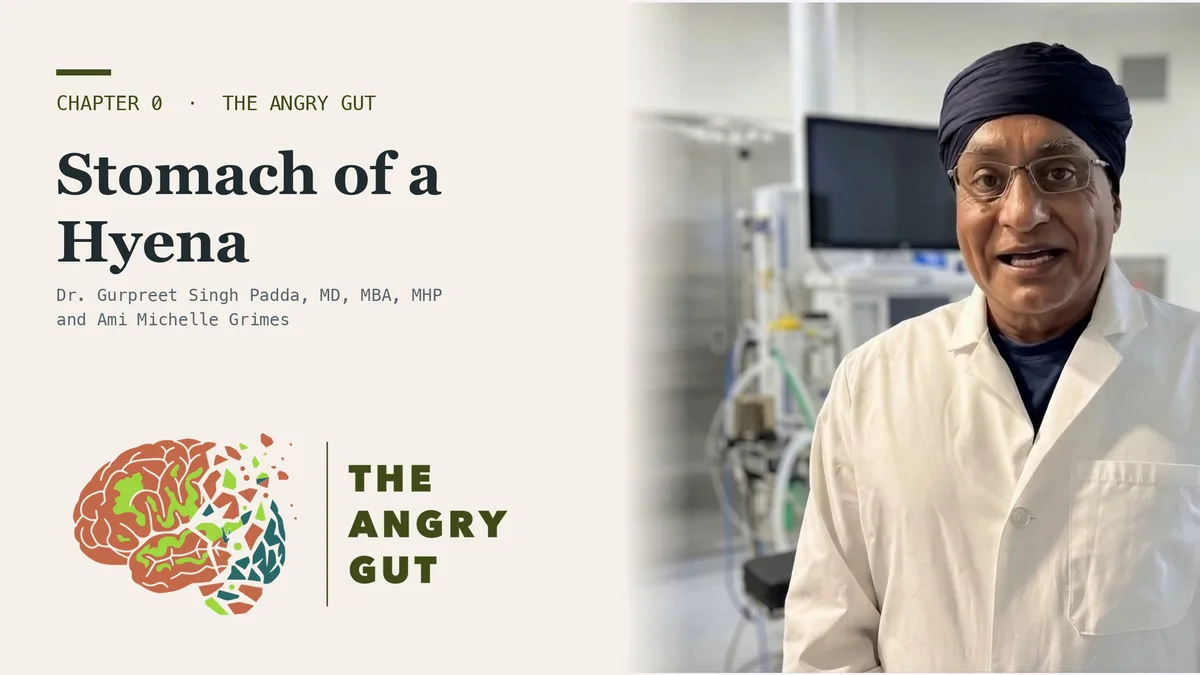
Your stomach is not a neutral pouch. It is a sterilizing gate set at a scavenger’s acidity, and anything you swallow, capsules of bacteria included, meets it first. In the video You Have the Stomach of a Hyena, Dr. Gurpreet Singh Padda, MD, MBA, MHP, lays out why the human stomach runs that strong. The question here is narrower and more practical: what that gate does to probiotics, and what the measurements actually show.
Stomach acid pH is a range, not a fixed number
In a comparison of stomach pH across 68 species, the human stomach was carried at pH 1.5, filed with the omnivores even though omnivores average 2.9 (Beasley et al., 2015). Young healthy adults with a calibrated capsule in the stomach had a fasting median of pH 1.7 (Dressman et al., 1990).
When 20 fasted healthy adults swallowed a continuously recording capsule, mean gastric values ranged from pH 1.7 to 4.7, and emptying took anywhere from 7 to 202 minutes, with a median of 30 (Koziolek et al., 2015).
Food moves the gate most of all. In the same capsule study that gave the 1.7, a standard meal pushed gastric pH to a median peak of 6.7, and it returned to fasted values in under two hours. That window is the most useful fact in this whole subject for anyone deciding when to swallow something alive.
What stomach acid does to swallowed probiotics
The killing has been measured in people. When a test bacterium was placed in the stomach of adults who make acid, almost all of it was gone within thirty minutes. In adults whose stomachs make none, nothing had been reduced an hour later. Plain hydrochloric acid at a matched pH killed just as well, so the acid is the agent (Giannella et al., 1972).
Sterilize the input at the gate, then cultivate the terrain downstream. The stomach is the gate. The colon is the field.
Probiotic survival figures come from the friendliest stomachs
When six volunteers drank a fermented milk with a meal, 1.5 percent of the Lactobacillus acidophilus reached the end of the small intestine alive, against 37.5 percent of the Bifidobacterium (Marteau et al., 1992). One meal, and a gap of twenty-five times between two species.
A second group intubated six fasting adults to collect ileal fluid continuously, then gave them 400 grams of fermented milk. Over eight hours they recovered 23.5 percent of the bifidobacteria, with a standard deviation of 10.4 (Pochart et al., 1992).
Three other strains followed through the gut arrived at 7, 1.0 and 0.5 percent, and none colonized. Measured in stool over a week of dosing, one of them averaged 25 percent survival with a standard deviation of 29 (Vesa et al., 2000). When the spread is larger than the average, the average describes nobody. Some people are a sieve and some are a wall.
Every one of those figures comes from a fed or buffered stomach, the kindest a capsule will ever meet. For probiotics, stomach acid in a fasting stomach near pH 1.5 lies outside what they tested.
Timing, fat and the best time to take probiotics
If a meal lifts the gate for under two hours, timing should matter, and in a dynamic model of the human stomach and duodenum it did. A four-strain capsule survived best when taken with a meal or 30 minutes before one, and did not survive in high numbers when taken 30 minutes after (Tompkins et al., 2011). Milk with 1 percent fat and an oatmeal gruel protected it better than apple juice or spring water, and fat content mattered more than protein.
That was a model rather than a person, run by the company that owns the strains, so read it as a direction: for most bacterial products the vehicle and the clock matter, and there is no single best time that fits every strain.
Coatings and spores change the math
The pharmaceutical answer is to keep the cells away from the acid. An ordinary capsule shell broke apart within 4 minutes in acid at pH 1.12, while a shell coated with an acid-resistant polymer stayed closed for the full two hours, then opened in intestinal buffer in 14 to 25 minutes with about 99 percent of the cells still viable (Fredua-Agyeman, 2024).
Spores are natural armor. In a dynamic model of the upper gut, 51 percent of a Bacillus coagulans spore dose was recovered past the stomach outlet, and 93 percent of those cells had already germinated (Keller et al., 2019). A separate spore product held a full hour at pH 1.5 with no significant loss, and acid alone woke 33.1 percent of the spores. Both are single-product lab results.
Arrival is not residence: why stool results mislead
When an 11-strain product was tracked by endoscopy instead of stool, the bacteria were viable after passing the stomach, but whether they settled on the gut lining depended on the person, the gut region and the strain, and stool could not see any of it (Zmora et al., 2018). The census is not the activity. A stool result tells you what passed through, not what took up residence or what it is doing.
The gate cuts both ways. In a randomized trial of 30 healthy adults, acid suppression helped a swallowed Streptococcus thermophilus colonize, and it also raised other bacterial families that normally stay out. An open gate is not a probiotic strategy.
Seeding the field is also not the same as feeding it. The cellulose-splitting bacteria present in 41 percent of apes turn up in no more than 4.6 percent of industrialized people. A food supply built on refined grain did that, and no capsule repays it. Terrain repair starts with what the field is fed, the same principle behind the gut-joint connection and our approach to metabolic inflammation.
Three questions before the next bottle
- Is it a spore or a non-spore bacterium? A spore shrugs off acid that kills most vegetative cells.
- Is the capsule acid-resistant, and does the label count viable cells at expiry or at manufacture?
- When are you taking it relative to food? The gate is lowest during the two hours after a meal.
Add one more if it applies: if you take an acid-suppressing drug, ask your physician what it is treating and what the plan is, rather than changing it yourself. A metabolic audit asks whether your body can heal before anyone tries to reseed it, and the gas a meal produces tells you what your colon can and cannot ferment.
The full evidence, with every study, every number and what each one does and does not show, is in the Chapter 0 Deep Dive. It is the companion to The Angry Gut, written by Dr. Padda with Ami Michelle Grimes. Next comes what a high CRP can and cannot tell you about an inflamed first brain.
Frequently asked questions
Do probiotics survive stomach acid?
Some do, and far fewer than the label count. In volunteers who took fermented milk with a meal, 1.5 percent of one Lactobacillus reached the small intestine alive against 37.5 percent of a Bifidobacterium. Those figures come from fed, buffered stomachs, so survival in a fasting stomach near pH 1.5 is likely lower. Spores and acid-resistant capsules survive far better. See why a probiotic is not a terrain strategy.
What is the best time to take a probiotic?
For most non-spore bacteria, with a meal or shortly before one. A meal raises stomach pH sharply and the acid returns to fasting levels within about two hours. In a model of the human upper gut, a capsule survived best with food or 30 minutes before eating, and poorly 30 minutes after. Fat in the meal protected it more than protein. Learn how a depleted gut field actually gets repopulated.
Are spore-based probiotics more likely to survive?
In laboratory models, yes. About 51 percent of a Bacillus coagulans spore dose was recovered past the stomach, most of it already germinated, and another spore product held a full hour at pH 1.5 without significant loss. These are single-product lab results, and a spore’s survival says nothing about whether it takes up residence in your gut. Read how a field is rebuilt after it has been emptied.
What is the normal pH of the human stomach?
Low and variable. Direct capsule measurements in young healthy adults gave a fasting median of pH 1.7, and 66 normal subjects all stayed between 1.0 and 2.5 over up to two days. After a meal the pH can climb to a median peak of 6.7 before falling back in under two hours. Find out whether stomach acid really fades with age.
Do acid reducers let more bacteria through?
The evidence suggests so. People taking a proton pump inhibitor carry more mouth-type bacteria in the gut, and in a randomized trial acid suppression helped a swallowed probiotic strain colonize while also raising other bacterial families. That is the same open gate working in both directions. Acid-suppressing drugs treat real conditions, so review yours with your physician. Understand when switching off the acid gate is worth it.
Test the terrain, not just the label
Regen.MD looks at the terrain a capsule lands in, from acid and medication history to the metabolic markers that decide whether the field can be farmed.
Questions? Call (314) 295-3000 or text (314) 886-5902.
Sources
- Dressman, J. B., Berardi, R. R., Dermentzoglou, L. C., Russell, T. L., Schmaltz, S. P., Barnett, J. L., & Jarvenpaa, K. M. (1990). Upper gastrointestinal (GI) pH in young, healthy men and women. Pharmaceutical Research, 7(7), 756–761. https://doi.org/10.1023/a:1015827908309
- Koziolek, M., Grimm, M., Becker, D., Iordanov, V., Zou, H., Shimizu, J., Wanke, C., Garbacz, G., & Weitschies, W. (2015). Investigation of pH and temperature profiles in the GI tract of fasted human subjects using the IntelliCap system. Journal of Pharmaceutical Sciences, 104(9), 2855-2863. https://doi.org/10.1002/jps.24274
- Giannella, R. A., Broitman, S. A., & Zamcheck, N. (1972). Gastric acid barrier to ingested microorganisms in man: studies in vivo and in vitro. Gut, 13(4), 251–256. https://doi.org/10.1136/gut.13.4.251
- Marteau, P., Pochart, P., Bouhnik, Y., Zidi, S., Goderel, I., & Rambaud, J. C. (1992). [Survival of Lactobacillus acidophilus and Bifidobacterium sp. in the small intestine following ingestion in fermented milk. A rational basis for the use of probiotics in man]. Gastroenterologie Clinique et Biologique, 16(1), 25–28. https://pubmed.ncbi.nlm.nih.gov/1537478/
- Pochart, P., Marteau, P., Bouhnik, Y., Goderel, I., Bourlioux, P., & Rambaud, J. C. (1992). Survival of bifidobacteria ingested via fermented milk during their passage through the human small intestine: an in vivo study using intestinal perfusion. The American Journal of Clinical Nutrition, 55(1), 78-80. https://doi.org/10.1093/ajcn/55.1.78
- Vesa, T., Pochart, P., & Marteau, P. (2000). Pharmacokinetics of Lactobacillus plantarum NCIMB 8826, Lactobacillus fermentum KLD, and Lactococcus lactis MG 1363 in the human gastrointestinal tract. Alimentary Pharmacology & Therapeutics, 14(6), 823–828. https://doi.org/10.1046/j.1365-2036.2000.00763.x
- Tompkins, T. A., Mainville, I., & Arcand, Y. (2011). The impact of meals on a probiotic during transit through a model of the human upper gastrointestinal tract. Beneficial Microbes, 2(4), 295-303. https://doi.org/10.3920/BM2011.0022
- Fredua-Agyeman, M. (2024). Surviving process and transit: Controlled freeze drying, storage and enteric coated capsules for targeted delivery of probiotic. Heliyon, 10(7), e28407. https://doi.org/10.1016/j.heliyon.2024.e28407
- Keller, D., Verbruggen, S., Cash, H., Farmer, S., & Venema, K. (2019). Spores of Bacillus coagulans GBI-30, 6086 show high germination, survival and enzyme activity in a dynamic, computer-controlled in vitro model of the gastrointestinal tract. Beneficial Microbes, 10(1), 77–87. https://doi.org/10.3920/BM2018.0037
- Zmora, N., Zilberman-Schapira, G., Suez, J., Mor, U., Dori-Bachash, M., Bashiardes, S., Kotler, E., Zur, M., Regev-Lehavi, D., Brik, R. B., Federici, S., Cohen, Y., Linevsky, R., Rothschild, D., Moor, A. E., Ben-Moshe, S., Harmelin, A., Itzkovitz, S., Maharshak, N., … Elinav, E. (2018). Personalized gut mucosal colonization resistance to empiric probiotics is associated with unique host and microbiome features. Cell, 174(6), 1388–1405.e21. https://doi.org/10.1016/j.cell.2018.08.041