

A partial rotator cuff tear is usually managed without surgery, and the research backs it: conservative care matches surgery for partial-thickness cuff tears, which are about twice as common as full-thickness ones.3,4 A review of non-surgical care says most studies, across many tear types and groups, show success in around 75% of cases.1 That figure is an overall summary, not a forecast for your shoulder. What it supports is a set plan without surgery before anything else.
Key takeaways
- A partial tear means the tendon is damaged but still attached to the bone.
- In one review of many tear types and groups, most studies reported about 75% success without surgery.1
- Rehab is the core of that plan, along with load management and changes to activity.
- Orthobiologics are considered when a structured conservative plan has been finished and symptoms still hold you back. They are not a substitute for it.
- Trial proof for injecting biologics into partial tears exists, but it is small. One randomized trial put 11 patients on cells taken from their own fat and 5 on a steroid shot.2
What is a partial rotator cuff tear, and why treat it without surgery first?
In a partial-thickness tear, the tendon is damaged but not fully pulled off the bone. Pain often comes from more than one source at once. It can come from the tendon itself, the bursa (a fluid sac), and the changed way the shoulder moves to work around the injury.
Because several structures play a part, a plan aimed only at the tendon often falls short. The evaluation is built to find out which of those sources is doing the most harm in your case.
This is the common tear, not the rare one. A 2024 scoping review notes that “Studies have shown partial-thickness rotator cuff tear (PTRCT) prevalence to be twice that of full-thickness tears.”3 And when surgery and non-surgical care are compared head to head, a 2026 meta-analysis of 33 studies and 1,818 patients found the surgical gains “remained below the minimal clinically important differences (MCID), indicating limited clinical relevance.”4 That is why we treat these tears with rehab, guided injection and PRP into the tendon where it fits, along with the metabolic work, and why we work to avoid surgery on them.
What the evaluation covers
- Limits on range of motion, and the movements that reliably bring on symptoms
- Strength testing and how the shoulder blade moves
- Imaging findings, and what they do and do not predict
- What has already been tried, for how long, and whether it was finished
How is a partial rotator cuff tear treated without surgery?
Physical therapy is the centerpiece. But a plan that is only a list of exercises tends not to hold. Load management, sleep position, and strength work for the shoulder blade as well as the cuff usually matter as much as work aimed at the tendon alone.
The elements of a plan you can actually follow
- Exercise aimed at strength and movement control
- Teaching on load management and progress guided by symptoms
- Hands-on and mobility work where it fits
- Image-guided shots in some cases, as one part of the plan, not a stand-in for it
How that order is built and tracked is described in our approach to conservative-first planning.
When is PRP used for a partial rotator cuff tear?
Orthobiologics come up when a structured conservative plan has been finished and the shoulder still holds you back. The goal is not to promise a structural repair of the tendon. It is to treat the tissue setting and the pain drivers that have not responded.
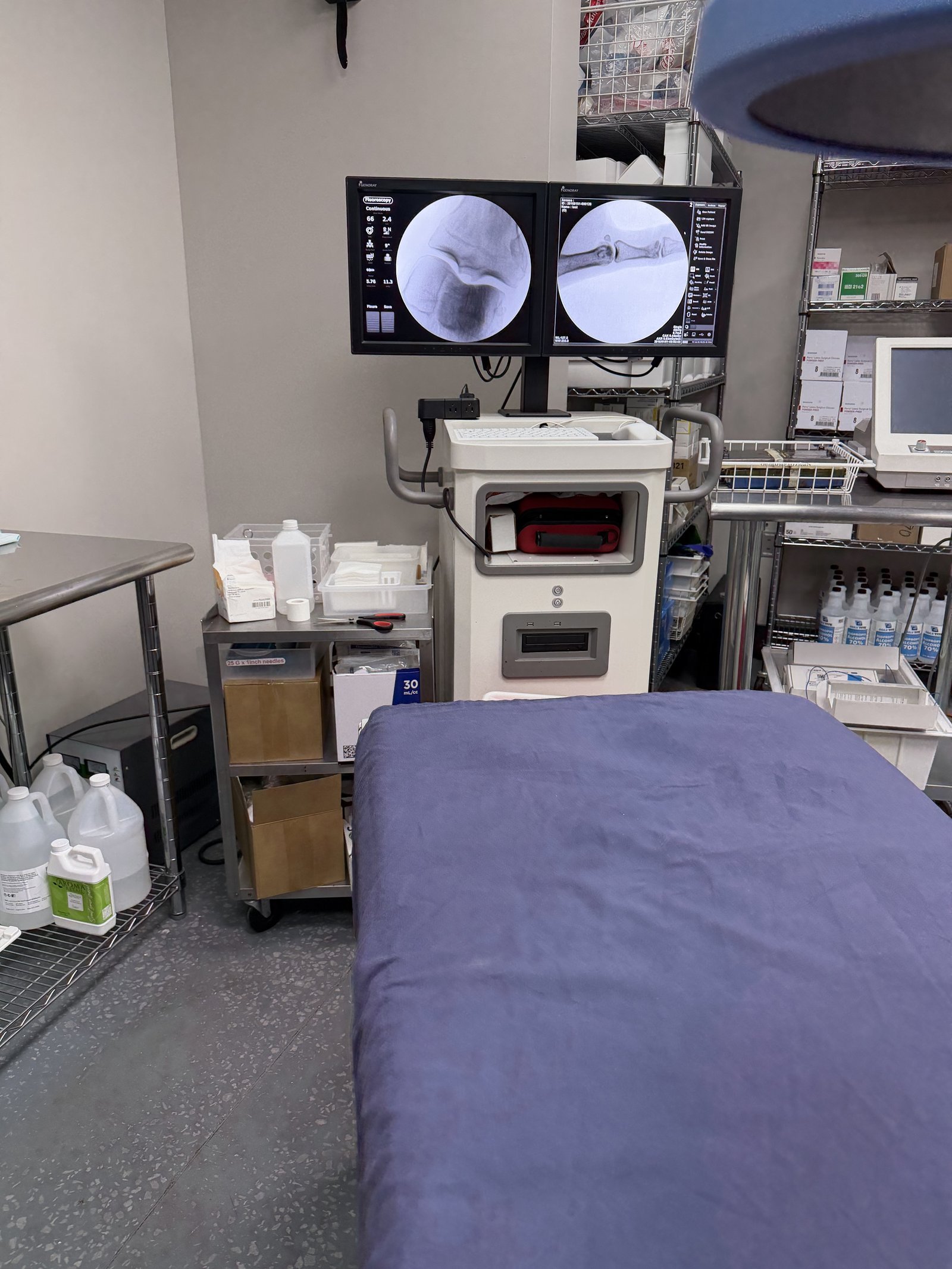
Delivery and targeting
Platelet-rich plasma approaches differ by where and how the material is placed. For shoulder problems, image guidance is used to reach the tissue where symptoms start. The rule is the same one behind every biologic decision here. The delivery has to match the target. One approach is not applied to every problem. The types are described under orthobiologic services.
What the trial evidence covers
One randomized trial studied painful partial tears in patients who had not improved after at least six weeks of physical therapy. One group got a single shot of cells from their own fat (autologous adipose-derived regenerative cells). The other got a single steroid shot.2 Patients were checked about 33 and 41 months later. The authors said the cell shot was safe and worked better than the steroid.
The trial enrolled 11 patients in the cell group and 5 in the steroid group.2 At that size, the result is a signal worth knowing about. It is not a basis for telling you what will happen.
The wider biological picture
A local shot is rarely the whole story. Whole-body inflammation and metabolic factors shape how tissue heals. So we check them in the same visit, not as a separate specialty. That includes topics under physician-directed peptide and longevity medicine. We discuss them as clinical topics. We do not sell them.
When conservative care has been exhausted
Regen.MD is conservative-first by design, and Dr. Gurpreet Singh Padda, MD, MBA, MHP is a surgeon. When conservative care has truly run out and the shoulder still holds you back, surgery is available and is discussed directly. Order matters. Surgery follows finished conservative care. It does not replace the attempt.
Find out what is actually driving your pain
Regen.MD begins with a physician-led Clinical Evaluation — a review of your history, imaging, and metabolic data, and a written terrain roadmap. Evaluation is contingent upon review of your data.
Questions? Call or text us.
Frequently asked questions
What does the 75% non-operative success figure actually mean for me?
Less than it sounds, and it pays to be clear about why. It is an overall summary across studies of mixed tear types, tear sizes, and age groups. It is not a rate measured in patients with your exact tear.1
It supports starting without surgery as a sensible default. It does not forecast your own result. The conditions we work through this way are listed on our conditions page.
Is there trial evidence for injecting biologics into a partial-thickness tear?
There is, and it is small. One randomized trial took patients who had not improved after at least six weeks of physical therapy. They got either a single injection of autologous adipose-derived regenerative cells or a single steroid injection. They were followed for more than three years.2
The trial reported the cell injection as safe and more effective than the steroid, with 11 patients in one group and 5 in the other. That is a real result, at a size that cannot settle the question. The wider evidence is collected in the Regen.MD library.
When do you stop conservative care and move on?
When a structured plan has truly been followed and the shoulder still limits what you need it to do. The bar is a plan actually finished, not a stretch of time gone by, because an unfinished rehab course tells you nothing about whether rehab would have worked.
What comes after that point is described on our shoulder surgery alternatives page.
Who evaluates the shoulder and decides the plan?
The Clinical Evaluation is physician-led. Dr. Gurpreet Singh Padda, MD, MBA, MHP reviews the history, exam, and imaging. He is a surgeon. So the talk about whether and when to operate happens with someone who does surgery, instead of being sent elsewhere.
His background and scope of practice are on the Dr. Padda page.
Will a partial rotator cuff tear get better without surgery?
Most do, and conservative care matches surgery for them in the pooled trial data, so we work to avoid an operation.4 A narrative review found that most studies report about 75% success with non-surgical care. The core is physical therapy, with load management, sleep position and strength work for the shoulder blade as well as the cuff. If a finished plan still leaves the shoulder holding you back, orthobiologics and then surgery are discussed.
Is PRP a good option for a partial rotator cuff tear?
PRP is considered after a structured conservative plan has been finished and the shoulder still holds you back. It is not a substitute for rehab. It is placed with image guidance so it reaches the tissue where symptoms start. The aim is to change the tissue setting and the pain drivers that have not responded, not to promise a structural repair of the tendon.
Sources
- Petri M, et al. “Non-Operative Management of Rotator Cuff Tears.” The Open Orthopaedics Journal, 2016. https://pmc.ncbi.nlm.nih.gov/articles/PMC5041208/
- Lundeen M, Hurd JL, Hayes M, et al. “Management of partial-thickness rotator cuff tears with autologous adipose-derived regenerative cells is safe and more effective than injection of corticosteroid.” Scientific Reports, 2023;13:19348. https://www.nature.com/articles/s41598-023-46653-4
- Eubank BHF, Sheps DM, Dennett L, et al. “A scoping review and best evidence synthesis for treatment of partial-thickness rotator cuff tears.” Journal of Shoulder and Elbow Surgery, 2024;33(3):e126-e152. PubMed 38103720. https://doi.org/10.1016/j.jse.2023.10.027
- Ricker E, Stehling L, Klute L, et al. “Surgical vs. non-surgical therapy for partial tears of the rotator cuff: a systematic review and meta-analysis of pooled studies with indirect comparison.” BMC Musculoskeletal Disorders, 2026;27(1). PubMed 42151917. https://doi.org/10.1186/s12891-026-09938-z