
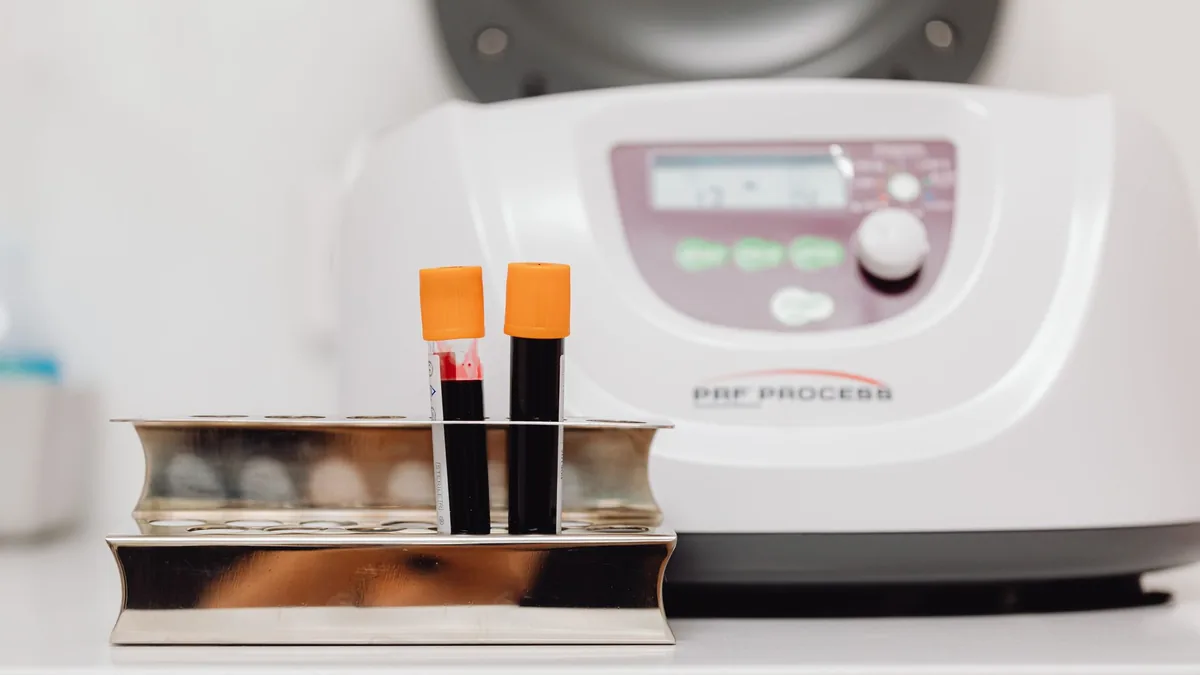
The choice among these three is made by matching the biologic to the tissue you want to change, not by ranking them. PRP, bone marrow aspirate concentrate, and micro-fragmented adipose come from different tissue. They are processed differently, and they work in different ways.1 The question that decides it is which tissue is causing your symptom. An exam and imaging answer that, not preference.
Key takeaways
- The three are not the same product at different prices. They start from different materials and work in different ways.1
- The choice follows the tissue target: the joint space, where a tendon or ligament meets bone, the bone under the cartilage, or the disc.
- In a randomized knee osteoarthritis trial, 175 of 195 assigned patients finished 12 months across three groups: BMAC 111, PRP 34, hyaluronic acid 30. They had Kellgren-Lawrence grades II to IV.2
- In that trial BMAC gave more clinical improvement than PRP and hyaluronic acid through 12 months. All three were safe, with few side effects.2
- For advanced knee osteoarthritis, PRP is discussed as a bridge therapy before joint replacement (arthroplasty). No orthobiologic regrows or regenerates cartilage.
How do you choose between PRP, BMAC and Lipogems?
Before any of the three is named, the evaluation has to find what is actually driving the symptom. A tendon junction problem, an inflamed joint space, a patch of bone under the cartilage, and a disc are four different targets. A biologic that suits one does not therefore suit the others.
That is why we treat orthobiologics as a group of truly different tools, not as one therapy with three brand names.
What is the difference between PRP, BMAC and Lipogems?
PRP concentrates platelets from your own blood and works mostly through platelet signals. BMAC is drawn from bone marrow and carries a different mix of cells and signals. Lipogems is fat tissue broken into small pieces by force, not by enzymes. A review of how the first two work describes them as distinct, not as stronger and weaker versions of one thing.1

Delivery is part of the choice, not an afterthought
PRP placed into the bone (intraosseous and subchondral delivery) targets the bone under the joint surface, not the joint space. When imaging and symptoms point to that area, the route matters as much as the preparation. Image guidance is what makes the difference real, not just a label.
Does BMAC work better than PRP for knee arthritis?
A randomized trial in knee osteoarthritis compared bone marrow aspirate concentrate against platelet-rich plasma and hyaluronic acid. Of 195 patients assigned, 175 finished the 12-month study. That was 111 in the BMAC group, 34 in the PRP group, and 30 in the hyaluronic acid group. Kellgren-Lawrence grades II to IV were spread across the groups with no significant difference.2
BMAC gave more clinical improvement than PRP and hyaluronic acid on most measures through 12 months. PRP had a small edge over hyaluronic acid that was not significant. All three were safe, with few side effects.2
What that trial does not settle
The groups were very unequal in size, follow-up stopped at 12 months, and Lipogems was not studied. A result in knee osteoarthritis does not carry over to a tendon problem or a disc. And a group-level difference does not tell you what your own response will be.
How the choice is made in the evaluation
The Clinical Evaluation is physician-led. It is where the decision is actually made, not just confirmed. Bring your MRI or X-ray reports. The more precisely the tissue target can be described, the less guesswork goes into the choice.
What gets determined
- Which tissue is causing the main symptom, and whether the bone under the cartilage is involved
- Whether a joint, tendon, intraosseous (bone) or intradiscal (disc) shot matches that target
- Whether PRP, BMAC, or micro-fragmented adipose fits the problem best
- What a past course that did not deliver tells us about the original target guess
- Whether whole-body and metabolic factors are working against repair
How that visit is set up is described in our approach to conservative-first planning. The wider evidence is collected in the Regen.MD library.
The advanced knee is a distinct conversation
When imaging shows end-stage change, PRP is discussed as a bridge therapy before joint replacement, not as a repair. That framing is not a hedge. It is what the trial evidence supports, and the detail is on our bone on bone knee PRP page.
When conservative care has been exhausted
Regen.MD is conservative-first, and Dr. Gurpreet Singh Padda, MD, MBA, MHP is a surgeon. When conservative care has truly run out, surgery is available and is discussed openly. It comes after conservative care runs out, not at the start of the conversation.
Find out what is actually driving your pain
Regen.MD begins with a physician-led Clinical Evaluation — a review of your history, imaging, and metabolic data, and a written terrain roadmap. Evaluation is contingent upon review of your data.
Questions? Call or text us.
How the procedure is governed here
For bone marrow aspirate concentrate, Regen.MD follows the American Society of Interventional Pain Physicians (ASIPP) guidelines for regenerative procedures. Who is a candidate, how it is done, and the aftercare are set in the physician-led evaluation, not by one rule applied to everyone.
Frequently asked questions
Is one of these three simply better than the others?
The evidence comparing them does not support one ranking for everyone. In one randomized trial of knee osteoarthritis, BMAC gave more clinical improvement than PRP or hyaluronic acid on most measures through 12 months. But the groups were unequal in size, and Lipogems was not in that trial at all.2
What the trial supports is a comparison within one condition over one year, not a general ranking. The conditions we apply this reasoning to are listed on our conditions page.
My first PRP did not work. Does that mean I should move to BMAC?
Not automatically. A course that did not deliver is a reason to recheck three things. Was the target tissue named correctly? Did the shot reach it? Was something whole-body working against the repair? Stepping up the biologic without answering those questions repeats the first guess.
The failure patterns we look for are set out on our page on why PRP injections fail.
Is Lipogems the same thing as BMAC?
No. Lipogems is micro-fragmented adipose tissue. BMAC is bone marrow aspirate concentrate. They start from different tissue, are processed differently, and are chosen for different cases.1
They are often compared because both come up after PRP. That is not a medical reason to treat them as equal. Each is described under orthobiologic services.
Does the same reasoning apply to spine problems?
The reasoning does. The tools change. When the target is the disc instead of a joint surface or a tendon, the delivery and goals are different enough that the knee comparison does not carry over directly. The first question is still which tissue is causing the symptom.
The spine pathway is covered on our back pain without surgery page.
Do BMAC injections work?
In a randomized knee osteoarthritis trial, 175 patients finished 12 months. BMAC gave more clinical improvement than PRP or hyaluronic acid on most measures. All three were safe, with few side effects. That is one trial in one condition over one year. Whether BMAC fits you depends on which tissue is causing your symptom, and the Clinical Evaluation decides that.
What is a BMAC procedure?
BMAC stands for bone marrow aspirate concentrate. It is drawn from your own bone marrow. It carries a different mix of cells and signals from PRP, which is concentrated from your blood. At Regen.MD, BMAC follows the American Society of Interventional Pain Physicians (ASIPP) guidelines for regenerative procedures. Who is a candidate, how it is done, and the aftercare are set in the physician-led evaluation.
Is Lipogems better than PRP?
Neither is better across the board. Lipogems is fat tissue broken into small pieces by force, not by enzymes. PRP concentrates platelets from your blood and works through platelet signals. The randomized trial on this page did not include Lipogems. The choice follows the tissue target: the joint space, a tendon junction, the bone under the joint, or a disc.
Sources
- Lana JFSD, et al. “Platelet-rich plasma vs bone marrow aspirate concentrate: An overview of mechanisms of action and orthobiologic synergistic effects.” World Journal of Stem Cells, 2021. https://pmc.ncbi.nlm.nih.gov/articles/PMC7933989/
- Dulic O, Rasovic P, Lalic I, Kecojevic V, et al. “Bone Marrow Aspirate Concentrate versus Platelet Rich Plasma or Hyaluronic Acid for the Treatment of Knee Osteoarthritis.” Medicina (Kaunas), 2021. https://pmc.ncbi.nlm.nih.gov/articles/PMC8623697/