
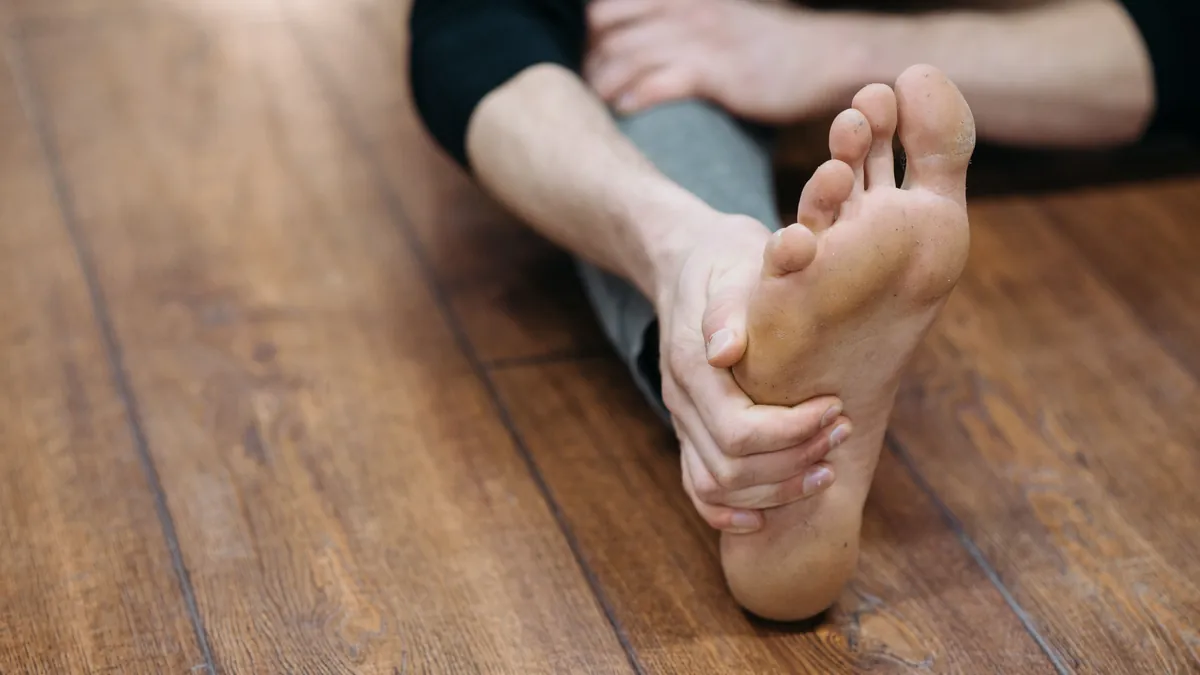
When first-line care for plantar heel pain has not worked, the orthobiologic options discussed at Regen.MD are physician-directed platelet-rich plasma (PRP), bone marrow aspirate concentrate (BMAC), and micro-fragmented adipose tissue (Lipogems). None of them is a first step. None of them is sold as a standard package. They are considered only after the diagnosis has been confirmed again and the current plan has truly stopped making a difference.
Plantar fasciopathy (damage to the thick band under the foot) is the most common cause of heel pain under the foot. It is one of the most common bone and muscle problems, and about 10% of people get it at some point in life. It is normally thought to go away on its own. But when symptoms last, they often go on for months or years [2]. So a long history is common, not unusual, among the people asking this question.
What should be checked before an injection for heel pain?
Persistent heel pain deserves a fresh review, not a faster escalation
Moving up to an injection only makes sense if the label on the problem is still correct. The published framework for this condition bases diagnosis on a detailed history and a physical exam. The exam includes pressing on the foot, the windlass test and the heel squeeze test. Imaging with X-ray, ultrasound or MRI is used only when needed, to rule out other causes such as tarsal tunnel syndrome or a stress fracture of the heel bone [1].
We treat that second look as the first task, not a formality. Heel pain that has not responded to a fair course of care is exactly where a second look at the diagnosis pays off.
What a Clinical Evaluation covers
Entry to Regen.MD is a physician-led Clinical Evaluation with Dr. Gurpreet Singh Padda, MD, MBA, MHP. It reviews your history, your imaging, and the metabolic picture under the joint or tendon problem. It ends with a written plan, not a same-day procedure.
Part of that talk is defining what “standard care failed” really means in your case. What was tried, for how long, at what dose or load, and what changed while you were doing it?
When should you consider PRP or other orthobiologics for plantar fasciitis?
The published sequence puts injectables late
The evidence-based framework for plantar fasciitis sorts thirty treatments into four phases. First come basic treatments such as rest, ice, compression, raising the foot, stretching and shoe inserts. Next come middle treatments such as light therapy (photobiomodulation) and extracorporeal shockwave therapy. Then come specialized treatments such as PRP and dry needling. Last comes surgery, kept for cases that will not respond. Its stated advice is to favor low-risk, high-benefit treatments first and move to invasive ones only when needed [1].
That order is the same one we use. When someone arrives asking about orthobiologics, the first question is which of the earlier steps were finished properly and which were dropped early.
Orthobiologics do not replace the rest of the plan
An injection is a biological input into tissue that still has to be loaded, rested, and rehabbed. Changing activity, building load step by step, and choosing footwear continue after the procedure. They are usually what decides whether the change holds.
Does PRP work for plantar fasciitis that has not responded to other care?
Not all PRP is the same
PRP is the orthobiologic most often asked about for stubborn heel pain. It does appear in the specialized tier of the published framework [1]. What that entry does not tell you is which preparation, which strength, and which tissue target were used. Those differ a lot between clinics.
Leukocyte-poor and leukocyte-rich preparations act differently. And a tendon or band target is not the same problem as a target inside a joint. We match the preparation to the tissue, instead of running one protocol for every case.
Why a course of PRP sometimes does not deliver
Some patients do not respond, and a sound plan says so up front. The common reasons are a diagnosis that was not quite right, a target that was missed, a preparation that did not fit the tissue, or a rehab phase that never happened.
Are BMAC or Lipogems an option for plantar fasciitis?
Autologous options discussed case by case
Bone marrow aspirate concentrate and Lipogems are both autologous, meaning the material comes from you. Both are discussed at Regen.MD within our orthobiologic services as options inside a structured path. They are chosen based on your imaging, exam, how long you have had symptoms, and how you responded to what you already tried.
They are not swappable with each other or with PRP. There is no version of this decision that can be made from a search result. It is made from your data.
When is surgery the right option for plantar fasciitis?
Regen.MD is conservative-first. Surgery is considered only after conservative care has run out. Dr. Gurpreet Singh Padda, MD, MBA, MHP is a surgeon, so that talk happens inside the practice, not as a referral away from it. In the published framework, surgery is likewise kept for cases that will not respond [1].
If you also have knee osteoarthritis, note that we frame PRP for advanced knee arthritis as a bridge therapy before joint replacement. It does not rebuild the joint surface, and we do not describe it that way.
Find out what is actually driving your heel pain
Regen.MD begins with a physician-led Clinical Evaluation — a review of your history, imaging, and metabolic data, and a written terrain roadmap. Evaluation is contingent upon review of your data.
Regen.MD, 4477 Woodson Rd, Suite 103, St. Louis, MO 63134, next to St. Louis Lambert International Airport. Call or text us.
Frequently asked questions
I have had heel pain for over a year. Does that mean the orthobiologic options failed before I started?
No. Plantar fasciopathy is normally thought to go away on its own, but lasting symptoms often go on for months or years. So a long history is common, not a reason to rule you out. What matters is whether the diagnosis still holds and whether the current plan has truly stopped making a difference. See how we structure a conservative-first plan.
Does PRP always work for plantar heel pain?
No. PRP sits in the specialized tier of the published treatment framework, not the first tier, and response varies between patients. Preparation, tissue target, and patient selection all differ between protocols. That is part of why some courses of PRP do not deliver what the patient expected. We cover this in detail in why PRP injections fail.
I already had a cortisone shot and it wore off. Does that change what we can consider?
It is useful information, not a barrier. What a steroid shot did, and for how long, tells us something about the tissue and about what drives the pain. See why cortisone shots can make heel pain worse.
What about shockwave therapy?
Extracorporeal shockwave therapy sits in the middle tier of the published framework, ahead of injections such as PRP. Where it fits in your order depends on what you have already finished. See our overview of shockwave therapy for chronic tendon pain.
What should I do about pain and anti-inflammatories after an injection?
Ask before you take anything. Medicine advice after the shot depends on the biologic used and on your own medical history. It is part of the written plan you leave with, not a generic rule. See rest, ice and ibuprofen after PRP for the reasoning we walk patients through.
What is the downside of PRP injections for plantar fasciitis?
The main downside is that some patients do not respond, and a sound plan says so up front. The usual reasons are a diagnosis that was not quite right, a target that was missed, a preparation that did not fit the tissue, or rehab that never happened. PRP is also not a first step. It sits in the specialized tier, after earlier care has been finished properly.
What actually fixes plantar fasciitis that will not go away?
Most plantar fasciopathy settles on its own, but lasting cases often go on for months or years. When it will not go away, the first step is confirming the diagnosis again. Tarsal tunnel syndrome or a heel bone stress fracture can look similar. Next is checking which earlier treatments were finished properly. Changing activity, building load step by step and choosing footwear are usually what make any change hold.
Sources
- Nweke TC. “Comprehensive Review and Evidence-Based Treatment Framework for Optimizing Plantar Fasciitis Diagnosis and Management.” Cureus, vol. 17, 2025. https://pmc.ncbi.nlm.nih.gov/articles/PMC12294660/ (diagnostic workup; four-phase treatment framework; sequencing of PRP, shockwave and surgery).
- Møller S, Riel H, Wester J, Simony A, Viberg B, Jensen C. “Surgical or non-surgical treatment of plantar fasciopathy (SOFT): study protocol for a randomized controlled trial.” Trials, vol. 23, 2022. https://pmc.ncbi.nlm.nih.gov/articles/PMC9531425/ (reported lifetime incidence of 10%; self-limiting course with symptoms often persisting months to years).