
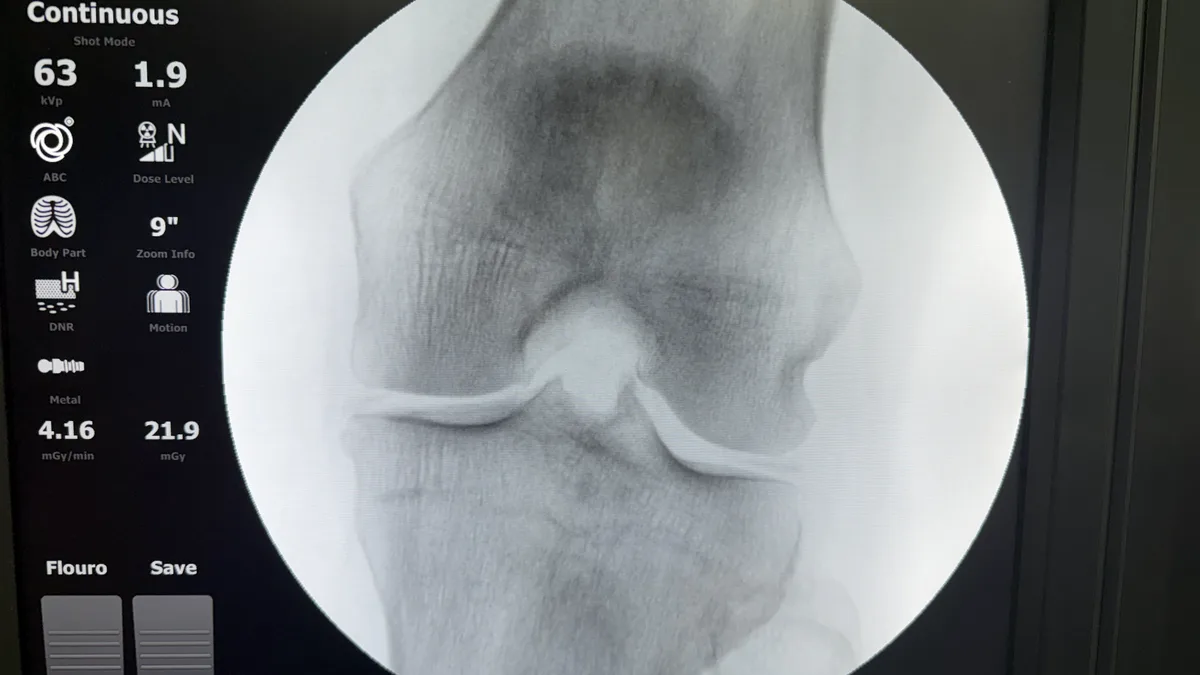
Your Kellgren-Lawrence grade describes what your knee X-ray shows, scored from 0 to 4. It mainly looks at osteophytes (bone spurs) and joint space narrowing. It does not measure how much pain you have, how far you can walk, or how soon you need surgery.
Two people can have the same grade and live very different days. That gap between the X-ray and the person is the most useful thing to know about the number on your report. It is what the rest of this article is about.
What does a Kellgren-Lawrence grade measure?
The Kellgren-Lawrence system is based on X-rays. It was built so doctors and researchers could describe how osteoarthritis looks on a plain X-ray in a steady, repeatable way. It is still the most widely used tool for diagnosing osteoarthritis on X-ray [1].
Two features do most of the work in the scale: bone spur growth and joint space narrowing. The scale also assumes those changes happen in a fixed order. First come bone spurs, then narrowing, then a change in the shape of the bone ends. Other authors have criticized that assumption [1].
What do Kellgren-Lawrence grades 0 to 4 mean?
Here is the full scale as described in the orthopedic literature [1]. Grades 1 and 3 exist and matter. Many online explanations skip straight from 0 to 2 to 4.
- Grade 0 — no joint space narrowing and no reactive changes.
- Grade 1 — doubtful joint space narrowing, possible osteophytic lipping.
- Grade 2 — definite osteophytes, possible joint space narrowing.
- Grade 3 — moderate osteophytes, definite joint space narrowing, some sclerosis, possible deformity of the bone ends.
- Grade 4 — large osteophytes, marked joint space narrowing, severe sclerosis, definite deformity of the bone ends.
Grade 4 is the picture most people mean when they say they were told they are “bone on bone.” It is an accurate description of an X-ray. On its own, it is not a treatment plan.
Why doesn’t my knee pain match my X-ray grade?
Pain and function come from more than the two features the scale scores. One known limit is that joint space narrowing without bone spurs cannot be captured by this system at all. That is a real problem for patients who have knee pain and cartilage loss on X-ray but no bone spurs on their films [1].
Research on how patients actually feel points the same way. The Osteoarthritis Initiative studied adults who either had knee osteoarthritis or were at higher risk of it. It measured quality of life against two definitions of knee osteoarthritis: one based on symptoms and one based on X-ray. The symptom-based definition did better. That suggests the pain itself is a key factor in quality of life with knee osteoarthritis [3].
So the grade is real information. It is just not the same information as how your joint feels to you.
How consistent is the grade itself?
Less steady than most patients assume. A score of how well two readers agree on the grade (interobserver reliability) has ranged from 0.51 to 0.89 across studies since the scale was first described [1]. Teachers who set out to build a standard training course for the scale noted that no standard training for grading existed. That may explain the poor reliability of the tool in osteoarthritis research [2].
In practice, the grade on your report is a trained reader’s judgment, not a lab value. A second reader might not write the same number.
What we do with your grade
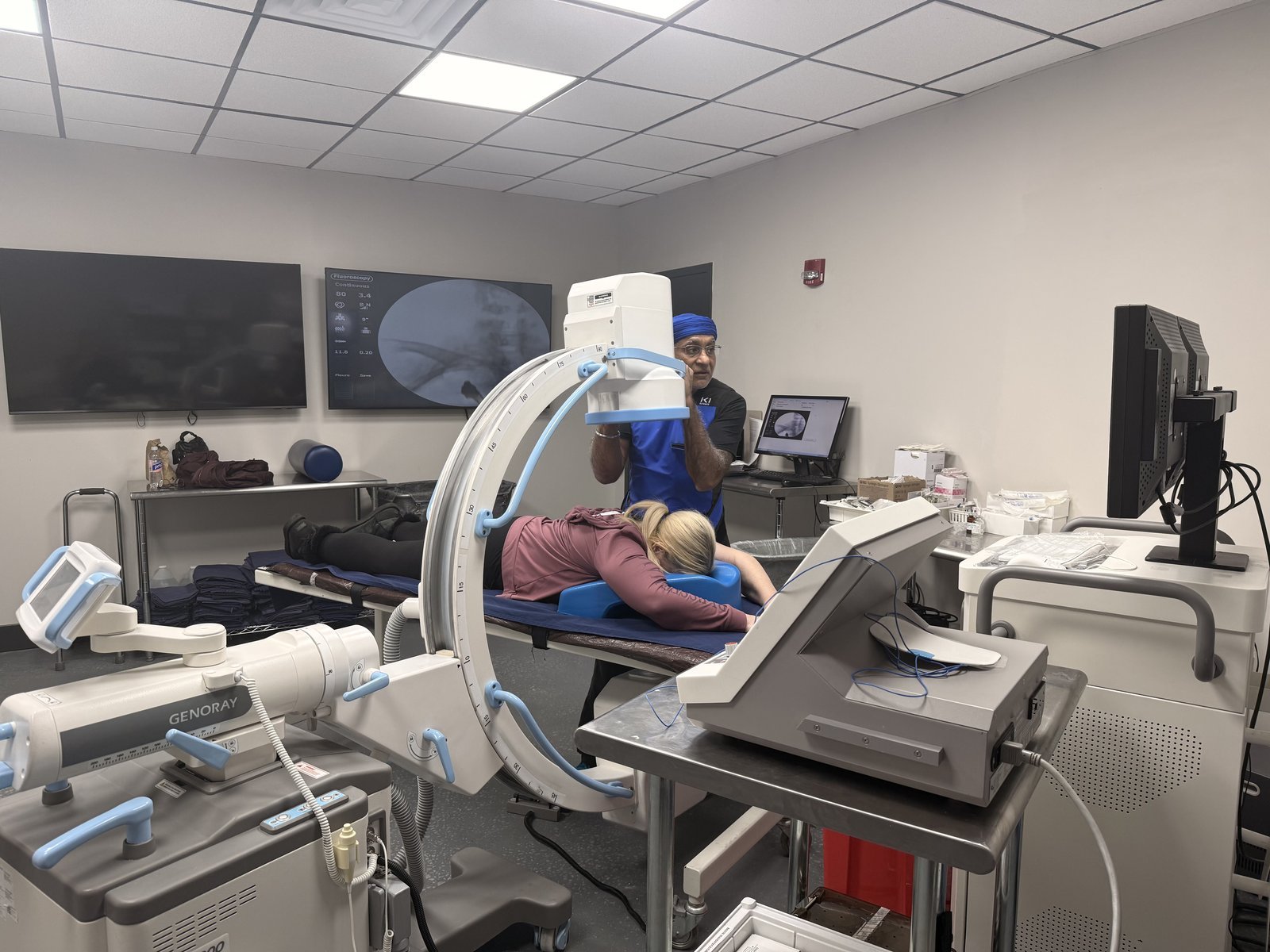
At Regen.MD in St. Louis, the grade is one input among several. We read it next to where your symptoms sit, what activities bring them on, how your exam looks, and what conservative care has been tried and for how long. That is the core of our conservative-first evaluation.
Where the clinical picture supports it, we discuss the orthobiologic options we offer. These are joint and tendon platelet-rich plasma, intraosseous and subchondral platelet-rich plasma, bone marrow aspirate concentrate, and Lipogems. For advanced knee osteoarthritis, platelet-rich plasma is discussed as a bridge therapy before joint replacement. No orthobiologic used here is claimed to rebuild lost cartilage.
When conservative care has truly run out, surgery is part of the plan, not an admission of failure. Dr. Gurpreet Singh Padda, MD, MBA, MHP is a surgeon, and the practice provides surgery at that point. It is never the first thing we reach for.
A grade means something different again in a joint that was injured, not worn out. That is the subject of the clock that starts on the day of the injury.
Find out what is actually driving your knee pain
Regen.MD begins with a physician-led Clinical Evaluation — a review of your history, imaging, and metabolic data, and a written roadmap for what to do next. Evaluation is contingent upon review of your data.
Questions? Call or text us.
Regen.MD, 4477 Woodson Rd, Suite 103, St. Louis, MO 63134, next to St. Louis Lambert International Airport.
Frequently asked questions
What does Kellgren-Lawrence grade 2 mean?
Grade 2 means definite bone spurs with possible joint space narrowing on the X-ray. It describes the film. It does not measure how much your knee hurts or how limited you are. That is why we read it alongside your exam and history when we evaluate knee osteoarthritis and the other conditions we treat.
Does a higher Kellgren-Lawrence grade always mean more pain?
No. The features the scale scores are not the only sources of knee symptoms. Research measured quality of life against symptom-based and X-ray-based definitions of knee osteoarthritis. The symptom-based definition did better. There is more on how imaging and symptoms differ in our patient education library.
Does my grade decide whether I need a knee replacement?
It does not decide it on its own. The grade describes how severe things look on X-ray. The decision rests on your symptoms, your function, your goals, and what conservative care has already achieved. Where an orthobiologic has a role, we explain it on our orthobiologics page. For advanced knee osteoarthritis it is framed as a bridge before joint replacement, not a substitute for it.
Can two readers give the same knee a different grade?
Yes, and the published data show it. How often two readers agree on the grade has ranged widely across studies. And no standard training for grading existed when teachers set out to build one. That is one reason your imaging is reviewed directly by Dr. Gurpreet Singh Padda, MD, MBA, MHP, not treated as a fixed number on a report.
What are the four stages of osteoarthritis?
On a knee X-ray, the Kellgren-Lawrence scale actually has five grades, 0 through 4. Grade 0 shows no narrowing or reactive changes. Grade 1 shows doubtful narrowing and possible bone spurs. Grade 2 shows definite bone spurs. Grade 3 adds definite narrowing and some hardening of the bone. Grade 4 shows large spurs, marked narrowing and bone deformity, the picture people call bone on bone.
Sources
- Kohn MD, Sassoon AA, Fernando ND. “Classifications in Brief: Kellgren-Lawrence Classification of Osteoarthritis.” Clinical Orthopaedics and Related Research, 2016. https://pmc.ncbi.nlm.nih.gov/articles/PMC4925407/ — referenced for the grade 0 to 4 descriptions, the scale’s status as the most widely used radiographic tool, the criticism of its assumed linear progression, the joint-space-narrowing-without-osteophytes limitation, and the 0.51 to 0.89 interobserver reliability range.
- Hayes B, Kittelson A, Loyd B, Wellsandt E, Flug J, Stevens-Lapsley J. “Assessing Radiographic Knee Osteoarthritis: An Online Training Tutorial for the Kellgren-Lawrence Grading Scale.” MedEdPORTAL, 2016. https://pmc.ncbi.nlm.nih.gov/articles/PMC6440422/ — referenced for the absence of standard training in grading and the unsatisfactory reliability of the tool in osteoarthritis research.
- Törmälehto S, Mononen ME, Aarnio E, Arokoski JPA, Korhonen RK, Martikainen J. “Health-related quality of life in relation to symptomatic and radiographic definitions of knee osteoarthritis: data from Osteoarthritis Initiative (OAI) 4-year follow-up study.” Health and Quality of Life Outcomes, 2018. https://pmc.ncbi.nlm.nih.gov/articles/PMC6069966/ — referenced for the comparison of symptomatic and radiographic definitions of knee osteoarthritis against health utility in the Osteoarthritis Initiative cohort.