
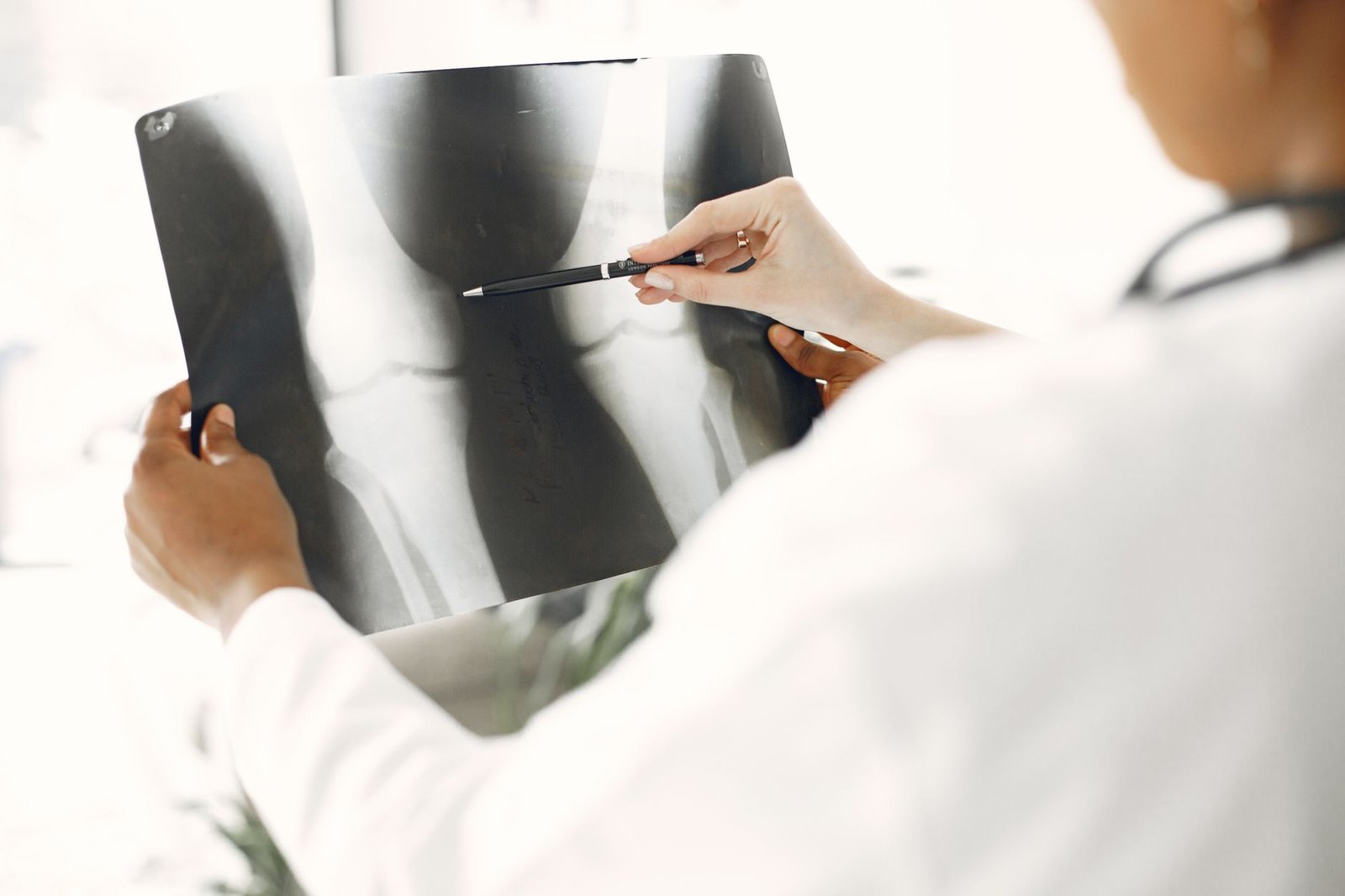
Post-traumatic osteoarthritis is arthritis that starts with an injury, not with years of wear. The impact kills cartilage cells. It tips the joint fluid toward breakdown. And it changes where load lands. All of this happens long before an X-ray shows any of it.
The most important number in this article is old, plain, and almost never told to patients. Roughly 12% of the overall prevalence of symptomatic osteoarthritis of the hip, knee and ankle in the United States is post-traumatic in origin. In the population estimate behind it, that is about 5.6 million people. It costs about $3.06 billion a year in direct cost.
One in eight symptomatic arthritic joints did not wear out. It was injured, and then the years did the rest.
What happens inside a joint after an injury?
The impact is not only mechanical. Three processes start at the moment of injury. None of them shows on the imaging ordered that week.
- Chondrocyte death. The jolt itself kills cells in the cartilage. Those cells kept the cartilage in repair. Fewer of them means slower upkeep in a tissue that was already slow to renew.
- A catabolic shift in the joint fluid. The joint lining reacts to blood and debris. The fluid the cartilage lives in changes. The enzymes that break cartilage down gain ground on the machinery that builds it. This is a chemical state, and it lasts long after the visible swelling is gone.
- Altered kinematics. A ligament that healed too loose, a meniscus that no longer spreads load, or a limb that is being guarded all change where load lands. Cartilage handles huge loads spread out correctly. It handles very little load piled up in the wrong spot.
Reviews of arthritis after anterior cruciate ligament (ACL) injury reach an uncomfortable conclusion worth saying plainly. Rebuilding the ligament restores stability. It does not reliably prevent the arthritis. A graft answers the mechanical half of a two-part problem. The chemical half is left exactly where it was, and it does not fix itself out of gratitude.
Can an ankle sprain lead to arthritis?
Knees and hips wear out for many reasons, so arthritis from injury hides in the crowd. The main ankle joint rarely wears out on its own. When an ankle is arthritic, there is usually an event in the history. It is also the joint most likely to have been brushed off at the time.
A systematic review and meta-analysis of first-time outer ankle sprains put leftover pain at 48.6% at three months, 21.5% at six months, and 6.7% at twelve. 15.8% sprained it again within the year. Most settle. The ones that do not are joints that have been loading wrong for a decade before anybody looks again.
Can arthritis after an injury be slowed down?
This is where the gloomy reading of the data goes wrong. The path is not fixed on day one. What is fixed on day one is the starting point. Three things stay changeable for years.
The chemical environment
A joint carrying low-grade inflammation breaks down faster than the same joint in a calm one. Whole-body inflammation feeds the local state. It is not a separate topic. It can be measured and treated, and it is the reason the metabolic audit is run before anything else here.
The loading pattern
Muscle that controls where load lands is the joint's only real protection. It is lost fast after an injury and regained slowly. This is not a fitness tip. It is a mechanical fix aimed at the thing that decides cartilage stress. The full case is in why load is the treatment.
What is done next, and what is not done
A ten-year randomized follow-up is useful here, though it studied degenerative tears, not injury tears. 140 people with a degenerative meniscal tear and little change on X-ray were randomized. They got either arthroscopic partial meniscectomy or twelve weeks of exercise therapy. At ten years, X-ray arthritis had developed in 23% of the surgery group and 20% of the exercise group. There was no real difference in reported outcomes or muscle strength.
Twelve weeks of structured exercise matched an operation over a decade. That is not an argument against surgery when surgery is needed. It is an argument that the treatment with the best ten-year record in that group was the one that changed how the joint was loaded.
Can an injection prevent post-traumatic arthritis?
Nothing has been shown to prevent post-traumatic osteoarthritis. A practice that tells you otherwise is selling. What the graded evidence supports is less pain and better function in established arthritis. The ESSKA-ORBIT consensus places its grade A statement on clinical effectiveness at Kellgren-Lawrence grade 3 or below. And a network meta-analysis found platelet-rich plasma, bone marrow concentrate and hyaluronic acid all beat corticosteroid on pain and function at six months or beyond.
So the honest plan for an injured joint is a long one. Manage the environment. Manage the load. Use a catalyst where a target and a window justify it. Recheck on a schedule, not when it gets bad enough to make you call.
Frequently Asked Questions
Is post-traumatic arthritis inevitable after a ligament injury?
It is not certain. But it is common enough that it should be planned for, not hoped away. The reviews agree that rebuilding a ligament restores stability without reliably preventing the arthritis. What the X-ray grade does and does not tell you along the way is covered in Kellgren-Lawrence knee osteoarthritis grading.
How long does it take for a post-traumatic joint to become symptomatic?
Usually years. That is exactly what makes it easy to ignore while it can still be changed. The gap between the event and the first bad X-ray is when terrain and loading are still deciding the outcome. It is the period described in Metabolic terrain: why joint degeneration is not only mechanical.
I am in my thirties and I injured my knee. Is that better or worse than doing it at sixty?
Better for biology and worse for strategy. A younger joint repairs more readily. It also has forty more years to spend under whatever conditions you set now. That is the argument against putting the question off. It is why the window before a joint replacement becomes the conversation matters more at that age, not less.
Does an early MRI finding of a bone bruise mean anything?
It can. Marrow signal under the cartilage after an impact shows the bone taking load the cartilage no longer spreads evenly. It is a marker worth following, not a curiosity. What those lesions mean over time is set out in Subchondral bone marrow lesions on knee MRI.
Can an injection stop this trajectory?
Nothing has been shown to prevent post-traumatic osteoarthritis, and we will not claim it. What can be treated is the inflammation and the loading pattern the joint lives in. That is an argument about symptoms and function, not structure. The difference is made carefully in Advanced knee osteoarthritis: when PRP is a bridge, not a substitute.
Can an injury turn into arthritis?
Yes. An injury can start arthritis on the day it happens. The impact kills cartilage cells. The joint fluid shifts toward breaking cartilage down. And the joint may start carrying load in the wrong places. None of this shows on the imaging taken that week. Years later the damage finally shows on an X-ray. That is why the injury is so often forgotten by then.
How common is arthritis after an injury?
More common than most people are told. Roughly 12% of painful hip, knee and ankle arthritis in the United States began with an injury. In the population estimate behind that figure, that is about 5.6 million people. Put simply, about one in eight arthritic joints did not wear out on its own. It was injured first.
What can I do to protect a joint after an injury?
Work on the three things that stay changeable for years. Calm the chemical environment, because a joint with low-grade inflammation breaks down faster. Rebuild the muscle that controls where load lands, since that muscle is the joint's real protection. Then recheck on a schedule instead of waiting until the pain forces a call. An injection is used only where a clear target and window justify it.
Find out what your recovery is actually limited by
Regen.MD begins with a physician-led Clinical Evaluation — a review of your history, your imaging and your metabolic data, and a written terrain roadmap before any procedure is discussed. Evaluation is contingent upon review of your data.
Questions? Call or text us.
Sources
- Brown TD, Johnston RC, Saltzman CL, et al. Posttraumatic osteoarthritis: a first estimate of incidence, prevalence, and burden of disease. J Orthop Trauma, 2006. PubMed 17106388 doi:10.1097/01.bot.0000246468.80635.ef
- Racine J, Aaron RK. Post-traumatic osteoarthritis after ACL injury. R I Med J, 2014. PubMed 25365816
- Wang LJ, Zeng N, Yan ZP, et al. Post-traumatic osteoarthritis following ACL injury. Arthritis Res Ther, 2020. PubMed 32209130 doi:10.1186/s13075-020-02156-5
- Kon E, Di Matteo B, Delgado D, et al. Platelet-rich plasma injections for the management of knee osteoarthritis: the ESSKA-ICRS consensus. Recommendations using the RAND/UCLA appropriateness method for different clinical scenarios. Knee Surg Sports Traumatol Arthrosc, 2024. PubMed 38961773 doi:10.1002/ksa.12320
- Laver L, Filardo G, Sanchez M, et al. The use of injectable orthobiologics for knee osteoarthritis: a European ESSKA-ORBIT consensus. Part 1 — blood-derived products (platelet-rich plasma). Knee Surg Sports Traumatol Arthrosc, 2024. PubMed 38436492 doi:10.1002/ksa.12077
- Jawanda H, Khan ZA, Warrier AA, et al. Platelet-rich plasma, bone marrow aspirate concentrate, and hyaluronic acid injections outperform corticosteroids in pain and function scores at a minimum of 6 months as intra-articular injections for knee osteoarthritis: a systematic review and network meta-analysis. Arthroscopy, 2024. PubMed 38331363 doi:10.1016/j.arthro.2024.01.037
- Michels F, Wastyn H, Pottel H, Stockmans F. The presence of persistent symptoms 12 months following a first lateral ankle sprain: a systematic review and meta-analysis. Foot Ankle Surg, 2022. PubMed 34961654 doi:10.1016/j.fas.2021.12.002
- Berg B, Roos EM, Englund M, et al. Arthroscopic partial meniscectomy versus exercise therapy for degenerative meniscal tears: 10-year follow-up of the OMEX randomised controlled trial. Br J Sports Med, 2025. PubMed 39326908 doi:10.1136/bjsports-2024-108644