
A Clinical Evaluation at Regen.MD is a full evaluation, not an intake visit. It has three set parts. First, a professional review of your medical history, imaging, and metabolic data before the session. Second, a full 60-minute physician-led talk about the root cause of your pain. Third, a written roadmap of your clinical terrain: the bottlenecks, the order of steps, and the tools that fit [1].
Diagnosis and treatment are two separate steps. The evaluation decides whether you need any procedure at all.
Why are labs and imaging required first?
The published stance is blunt. A sales consult is a pitch. This visit is a doctor’s close look at your history, scans, and lab data, then a root-cause talk and a written plan [2]. We take patients only after the needed labs and scans are in, because the visit is a study of that data [1].
That rule is there for a medical reason, not a paperwork one. Procedures placed into an unmeasured terrain fail. The practice will not spend your money proving it [1].
What do you need to send before the evaluation?
Metabolic markers
The form asks if you track metabolic health markers: fasting insulin, HbA1c, hs-CRP, and lipids. If you do not have that data, the team orders the needed blood tests before the visit. We do not go ahead without them [1].
Imaging and prior procedures
Related MRI, ultrasound, or CT reports are requested if they exist. So is a history of past procedures with rough dates and results [1]. Failed procedures count as data, because they show what the terrain rejected [1].
Applications are handled through a HIPAA-compliant intake platform [1].
What happens during the 60-minute physician-led session?
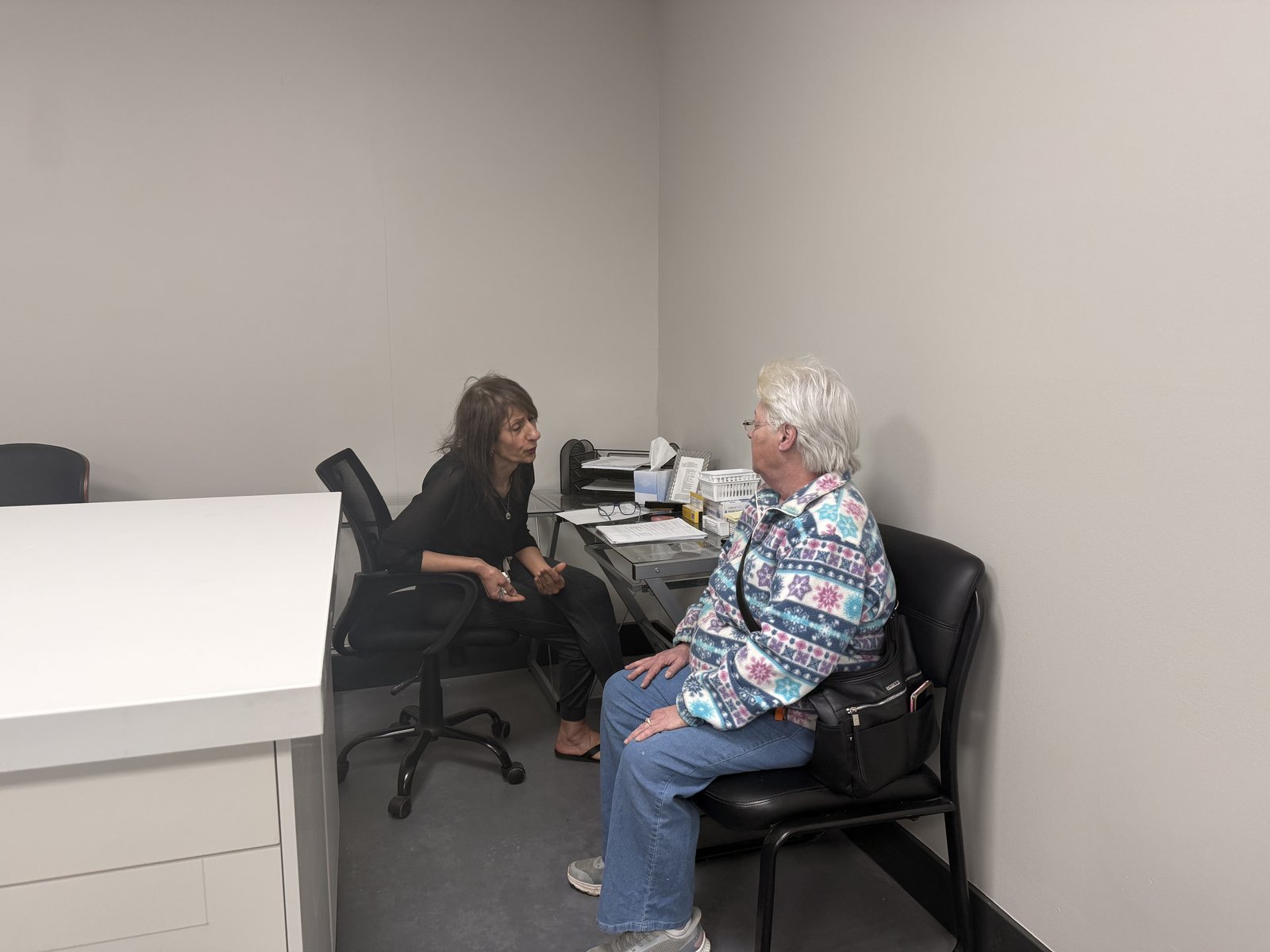
The session is a full talk about the root cause of your pain, not a review of paperwork you already sent [1]. Because the data review happens first, the visit time goes to making sense of it and making decisions.
The core idea is described on the terrain philosophy page. Repair depends on the setting the tissue is being asked to heal in, not only on what shows up on a scan [3]. Inflammation is read as a signal about your capacity to recover and the energy and materials you have on hand. It is not just a finding to be silenced.
What is in the written terrain roadmap?
The evaluation produces a written roadmap that lays out the bottlenecks, the order of steps, and the tools that fit [1]. It is a document to support your decision. You leave with the reasoning in writing, not with spoken advice you have to piece together later.
What the roadmap contains comes out of the data review. It is not a template. It is written only after there is something to read. That is why the evaluation depends on getting the metabolic and structural data first [1].
When does the roadmap point toward orthobiologics?
If the findings support it, the plan ties into the orthobiologics service. Options include PRP placed into the bone (intraosseous and subchondral), bone marrow aspirate concentrate, Lipogems, and intradiscal orthobiologics. Which one fits, and when, next to fixing your metabolism, is why we write a sequence instead of naming one procedure.
Peptide and longevity medicine topics come up when they match the bottlenecks found in the review. They are discussed as clinical and teaching topics. They are not sold as products.
If your goal is to avoid a joint replacement
For advanced knee osteoarthritis, PRP is framed the way the trial authors framed it: as a safe bridge therapy prior to arthroplasty. No orthobiologic we offer is claimed to regrow or regenerate cartilage. The visit is built to find out if a bridge is realistic for you, not to assume it.
Regen.MD does provide surgery when conservative care has run out, and Dr. Gurpreet Singh Padda, MD, MBA, MHP is a surgeon. Surgery comes after conservative care runs out. It is not the opening move.
Preparing before you apply
The Masterclass is a clinical education series of fifty episodes. It covers the biology of pain, inflammation, metabolism, and repair. It is meant to be watched before an evaluation [2]. Patients who work through it arrive sharing the same words for the session. That changes what an hour can cover.
Where the evaluation takes place
Regen.MD is located at 4477 Woodson Rd, Suite 103, St. Louis, MO 63134, next to St. Louis Lambert International Airport. The clinical team handles applications and scheduling.
Frequently asked questions
What do I need to have ready before the session?
A list of past procedures with rough dates and results. Metabolic health markers if you have them: fasting insulin, HbA1c, hs-CRP, and lipids. And any MRI, ultrasound, or CT reports for the problem. If the lab data is missing, the team orders the needed blood tests first. How those markers tie to tissue repair is discussed alongside physician-directed peptide therapy as a medical topic.
Will the evaluation tell me whether I can avoid a joint replacement?
It will tell you what your data supports and in what order. That is a more useful answer than yes or no. Where joint replacement is already advised, platelet-rich plasma is framed as a bridge therapy before surgery, not as a way to rebuild lost cartilage. The broader context is on our surgical alternatives page.
Where does the evaluation take place?
At the clinic at 4477 Woodson Rd, Suite 103, St. Louis, MO 63134, next to St. Louis Lambert International Airport. Directions, parking, and clinic details are on the locations page.
What happens at a regenerative medicine consultation?
At Regen.MD the consultation is a Clinical Evaluation with three parts. First, your medical history, imaging, and metabolic data are reviewed before you arrive. Second, you have a 60-minute physician-led talk about the root cause of your pain. Third, you get a written roadmap of the bottlenecks, the order to tackle them, and the tools that fit. So the reasoning goes home with you on paper.
Who is a good candidate for regenerative medicine?
That is what the evaluation decides. Orthobiologics are used only when your history, imaging, and metabolic data support them. The written roadmap names which one fits and in what order next to metabolic correction. Cases are accepted once the required labs and imaging are in, because a procedure placed into an unmeasured terrain fails, and we will not spend your money proving it.
Does regenerative medicine actually work?
It depends on what you expect it to do and on the terrain it goes into. No orthobiologic we offer is claimed to regrow or regenerate cartilage. For advanced knee osteoarthritis, PRP is framed as a safe bridge before joint replacement. The visit finds out if that bridge is realistic for you before any procedure is booked.
Key takeaways
- The Clinical Evaluation has three parts. We review your history, scans, and labs first. Then you get a 60-minute root-cause talk with the doctor. Then you get a written terrain plan.
- We take cases only after the needed labs and scans are in, because the visit is a study of that data.
- The roadmap names the bottlenecks, the order to tackle them, and the tools that fit. Orthobiologics come in only if the data supports them.
- For advanced knee osteoarthritis, PRP is a bridge before joint replacement. Surgery comes after conservative care has run out.
This article is educational and is not a substitute for evaluation, diagnosis, or treatment by a physician. Individual results vary, and not every patient is a candidate for the therapies described. Do not start, stop, or change any treatment without consulting your physician.
Find out what is actually driving your pain
Regen.MD begins with a physician-led Clinical Evaluation — a review of your history, imaging, and metabolic data, and a written terrain roadmap. Evaluation is contingent upon review of your data.
Questions? Call or text us.
Sources
- Regen.MD. “Application for Clinical Evaluation.” 2026. https://regen.md/contact/
- Regen.MD. “The Masterclass — Clinical Education Series.” 2026. https://regen.md/patient-resources/
- Regen.MD. “The Terrain — Our Philosophy of Care.” 2026. https://regen.md/our-approach/