
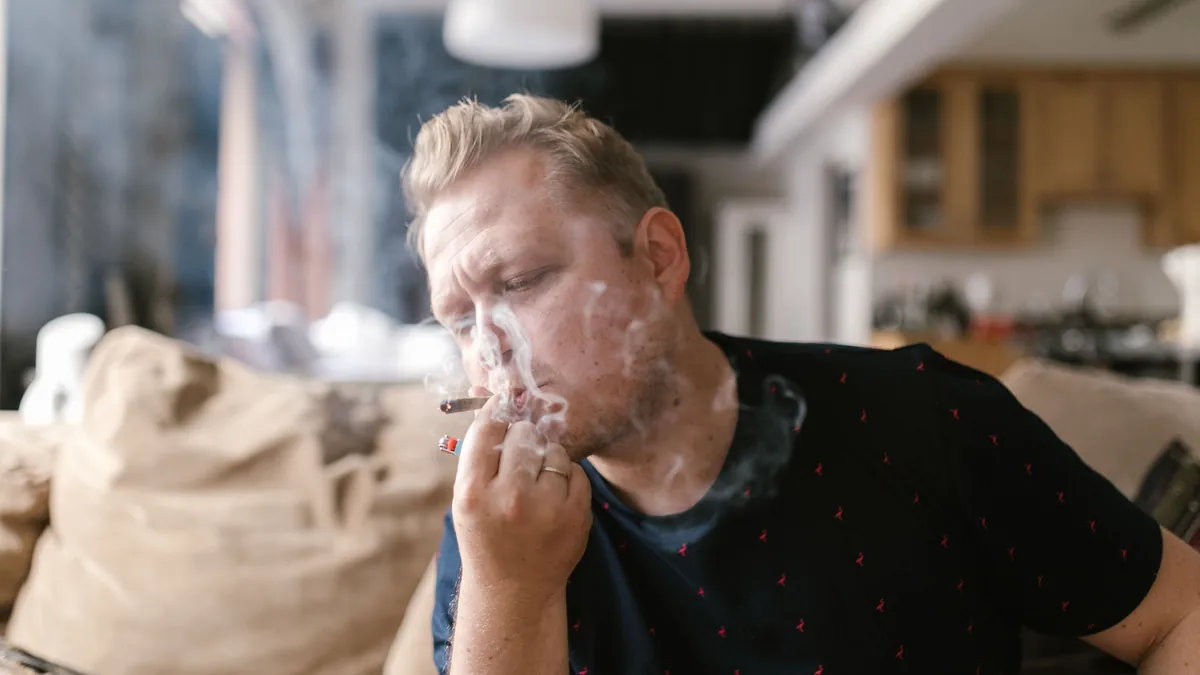
Nicotine and smoking act on tendon and bone repair through the blood supply and the cells that build new tissue. That is why recovery can lag even when rehab is done well. In a rat Achilles tendon model, tendons exposed to nicotine had significantly fewer blood vessels than controls. They were measurably weaker at 42 days.1 In human cells, it was whole cigarette smoke extract, not nicotine alone, that slowed wound closing and harmed bone-building ability. That difference is worth understanding before you plan a procedure around it.2
Key takeaways
- In a rat Achilles tendon injury model, nicotine cut the number of blood vessels at the repair site.1
- In the same model, healed tendon at 42 days carried 44.7% less maximum load and was 35.0% less stiff than saline controls.1
- In human stem-like cells grown in a dish (mesenchymal stromal cells), cigarette smoke extract, not nicotine alone, slowed wound closing more as the dose rose. It also cut calcium buildup.2
- Among 126 patients followed at least two years after arthroscopic rotator cuff repair, the 18 smokers improved less on one shoulder score. They did not improve less on pain or the other outcome measure.3
- None of this data tells you what will happen to your own repair. It tells you which factors are worth removing before the healing window opens.
Does nicotine weaken a healing tendon?
The clearest tendon evidence comes from a controlled rat study. 60 adult male Sprague-Dawley rats got either saline or nicotine at 61 ng/mL through pumps placed under the skin. It started three months before injury and continued throughout.1 The animals were checked at 21 and 42 days after a full-thickness Achilles injury.
Blood supply at the repair site
Under the microscope, the tendons exposed to nicotine had significantly fewer blood vessels than controls. Ultrasound showed slower blood inflow.1 Tendon repair depends on that inflow to bring cells, oxygen, and signals. So a thinner network of blood vessels is a plausible mechanism, not a side finding.
Mechanical strength at 42 days
By 42 days, the nicotine group’s healed tendons carried 44.7% less maximum load and were 35.0% less stiff than controls. They were also thinner and relaxed less under stress.1 Tissue that looks healed on a timeline does not always perform under load. This is the study that tells those two things apart.
What does smoking do to bone-forming cells, and is nicotine the problem?
A 2024 lab study exposed human mesenchymal stromal cells, the cells that support bone building, to two things. One was cigarette smoke extract standardized to nicotine content. The other was nicotine alone.2 The two did not act the same way, and the difference matters for how this topic is usually described.
Wound closure and cell survival
Cigarette smoke extract slowed wound closing more as the dose rose. At high levels of 3,200 to 4,500 ng/mL, the cells shrank, came loose, and died.2 Nicotine alone did not cause a similar dose-driven slowdown in these cells.
Bone-forming capacity
Smoke extract also cut calcium buildup more as the dose rose, while the cells were turning into bone cells. Nicotine at the same levels had almost no effect on calcium buildup or alkaline phosphatase activity.2 In this cell model, the parts of smoke other than nicotine did the harm on the bone side.
Do smokers recover less after rotator cuff surgery?
In a group of 126 patients followed at least two years after arthroscopic rotator cuff repair, 18 patients were smokers. That is 14% of the group.3 Both groups improved by a meaningful amount. But the smokers gained less on the ASES shoulder score, improving 19.4 points against 35.2 points in non-smokers.
The same report notes that smokers arrived with more pain, more other health problems, and worse shoulder scores at the start. And the difference did not carry over to the pain scale or the other function measure used.3 This is a real signal in a modest group, not a verdict.
Does smoking affect PRP and other orthobiologic treatment?
Every orthobiologic we use is autologous, meaning it comes from you. It works by asking your own repair biology to respond. When the blood vessel network at the repair site is thinner, and the cells around it are under chemical stress, you are asking the same procedure to work against more resistance.
Timing around the healing window
The animal data measured at 21 and 42 days after injury. That is a reminder that the first weeks are biologically active, not quiet.1 Where cutting exposure is possible, it is most worth the effort across that window, and we build the schedule around it. We describe how that ordering works in our approach to conservative-first planning.
Where PRP, BMAC, and Lipogems fit
Nicotine use does not by itself pick one biologic over another. The tissue target and the medical reason do that. It does change what we tell you to expect and how closely we track the response. The types we work with are set out under orthobiologic services.
When conservative care has been exhausted
Regen.MD is conservative-first, and Dr. Gurpreet Singh Padda, MD, MBA, MHP is a surgeon. When conservative care has truly run out, surgery is still available. It is discussed openly, not treated as a failure of the plan. For the shoulder, that decision point is covered on our shoulder surgery alternatives page.
Find out what is actually driving your pain
Regen.MD begins with a physician-led Clinical Evaluation — a review of your history, imaging, and metabolic data, and a written terrain roadmap. Evaluation is contingent upon review of your data.
Questions? Call or text us.
Frequently asked questions
Does nicotine by itself harm healing, or is it the rest of the smoke?
Both questions have answers, and they are not the same answer. In the rat Achilles model, nicotine alone was enough to cut blood vessels and strength in healing tendon. In the human bone-marrow cell study, whole cigarette smoke extract slowed wound closing and harmed bone-building ability. Nicotine alone at the same levels did not.
The honest summary is this. Nicotine is not neutral for tendon. And the non-nicotine parts of smoke carry their own separate burden for bone-building cells. More background reading is collected in the Regen.MD library.
Will quitting before a procedure change my result?
No study cited here randomly assigned patients to quit before an orthobiologic injection. So we cannot promise you a specific gain. What the evidence supports is narrower but still useful. Nicotine was linked to fewer blood vessels and weaker healed tendon in the animal model. And smokers in the rotator cuff repair group improved less on one of three outcome measures.
Cutting exposure removes a factor that works against the repair environment. How we fit that into the rest of a plan is described in our conditions and care pathway pages.
If I still use nicotine, will you refuse to treat me?
No. Nicotine use is a factor we account for in planning and in the expectations we set with you. It is not a gate we use to turn people away. It changes the talk about timing, about how we track the response, and about how much of the outcome we credit to the injection itself.
Whole-body and metabolic factors are handled in the same visit. That includes topics covered under physician-directed peptide and longevity medicine, which we discuss as clinical topics, not products.
Who reviews my imaging and builds the plan?
The Clinical Evaluation is physician-led. Dr. Gurpreet Singh Padda, MD, MBA, MHP reviews your history, imaging, and metabolic data. The roadmap that results is written down, not spoken and forgotten.
His background and scope of practice are set out on the Dr. Padda page.
Do smokers take longer to heal?
Recovery can lag, and the studies here show why. In a rat Achilles model, nicotine left the repair site with fewer blood vessels. The healed tendon carried 44.7% less load at 42 days. Among 126 patients after rotator cuff repair, the 18 smokers improved 19.4 points on the ASES shoulder score, against 35.2 for non-smokers, though not on pain.
What does smoking do to your bones?
A 2024 study looked at human mesenchymal stromal cells, the cells that support bone building. Cigarette smoke extract slowed wound closing and cut calcium buildup as the dose rose. At high levels, the cells died. Nicotine alone at the same levels had almost no effect on calcium buildup. In that model, the rest of the smoke did the damage to bone-building cells.
What slows down tendon and bone healing?
Repair depends on blood flow that brings cells, oxygen and signals to the injury. It also depends on healthy cells that build new tissue. Anything that thins the blood supply or puts those cells under chemical stress works against the repair, and smoking does both. Whole-body and metabolic factors count too. That is why they are reviewed in the same Clinical Evaluation.
Sources
- Cheema AN, Newton JB, Boorman-Padgett JF, Weiss SN, Nuss CA, Gittings DJ, Farber DC, Soslowsky LJ. “Nicotine Impairs Intra-Substance Tendon Healing After Full Thickness Injury in a Rat Model.” Journal of Orthopaedic Research, 2018. https://pmc.ncbi.nlm.nih.gov/articles/PMC6411046/
- Heikkinen J, Tanner T, Bergmann U, Palosaari S, Lehenkari P. “Cigarette smoke and nicotine effect on human mesenchymal stromal cell wound healing and osteogenic differentiation capacity.” Tobacco Induced Diseases, 2024;22. https://www.tobaccoinduceddiseases.org/Cigarette-smoke-and-nicotine-effect-on-human-mesenchymal-stromal-cell-wound-healing,185281,0,2.html
- Naimark M, Robbins CB, Gagnier JJ, Landfair G, Carpenter J, Bedi A, Miller BS. “Impact of smoking on patient outcomes after arthroscopic rotator cuff repair.” BMJ Open Sport & Exercise Medicine, 2018;4(1):e000416. https://pmc.ncbi.nlm.nih.gov/articles/PMC6267295/