
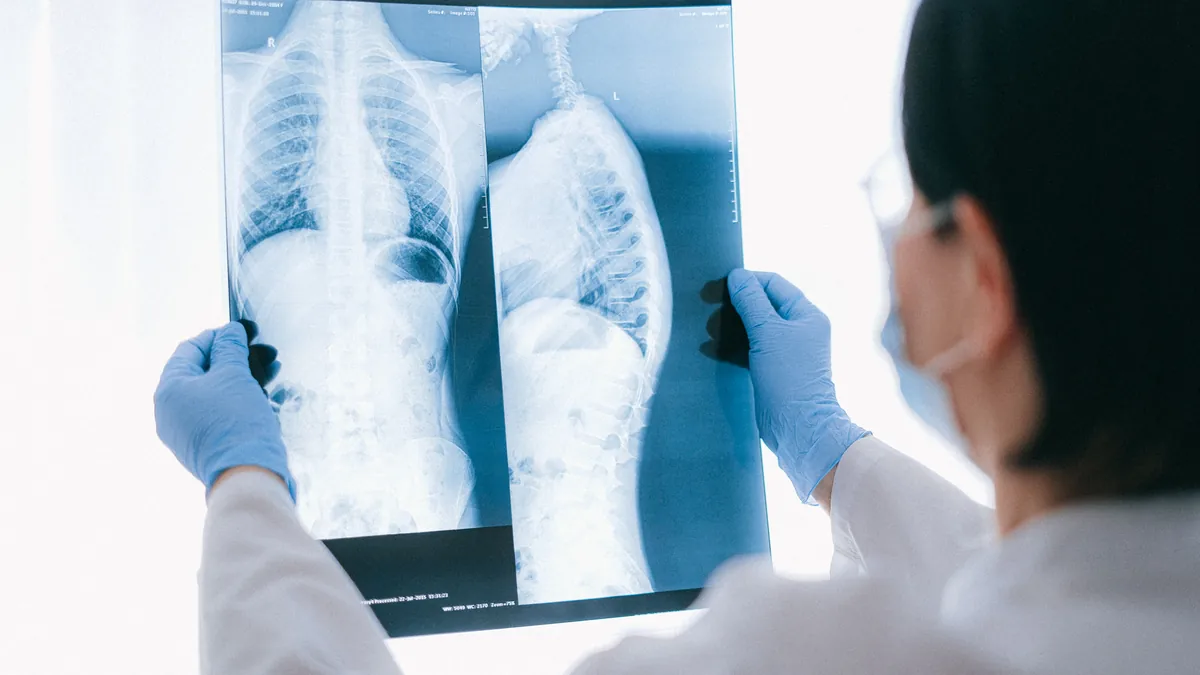
Intradiscal PRP at Regen.MD places high-dose leukocyte-rich PRP into the disc. We take 80 cc of your blood and concentrate it to 2 cc. Gentamicin, an antibiotic, is mixed into the contrast dye to target C. acnes bacteria. Expect an inflammatory flare for three days to three weeks, because the protocol sparks a repair response instead of numbing the nerve.
The usual model treats your spine as a machine: a stack of parts, one of which has worn out. That view drives everything that follows. Scan it, find the worn part, then numb it or remove it.
We see the spine as a living ecosystem. A disc is living tissue with a blood supply problem, a metabolic setting, an immune status, and sometimes, it turns out, a population of bacteria. Treat it as hardware, and every treatment aims to mute a signal. None of them aims at the biological weakness causing it.
This article explains what an intradiscal regenerative approach involves. It also explains why the preparation before the needle matters as much as the injection.
Why we strictly avoid corticosteroids in the disc
Steroids are the common answer, and they do something real. They strongly suppress the immune system, and that lowers pain for a while. What they do not do is give any structural benefit. The disc is no better afterward. It just reports its problem more quietly.
There is a further concern with repeat shots. Evidence suggests quarterly steroid injections may actually speed up cartilage loss and worsen joint health over time. That is a real trade to make knowingly. Most patients are never told it is a trade at all.
Our goal is different. We work on the metabolic health and nervous system control that let the pain become chronic in the first place.
Pre-procedural optimization and the gut–disc axis
You cannot treat spine pain for the long run without addressing the metabolic environment. Two inputs matter so much that we work on them before we work on the disc.
Metabolic health. Obesity and type 2 diabetes feed inflammation in the disc. They create a chemical setting that speeds up breakdown. So the disc is not simply wearing out from load. The chemistry around it is actively breaking it down.
The gut microbiome. An unbalanced gut makes the gut wall leakier. Bacterial byproducts then get into the bloodstream and drive whole-body inflammation that targets the spine. This is the gut–disc axis. It explains why a disc can keep breaking down in a patient who has done everything right mechanically.
Phenotyping. Not all back pain comes from the disc. Injecting a disc that is not the pain source helps no one. We look for specific signs before going ahead. Pain that runs horizontally, side to side, and trouble sitting for long are strong signs that the disc is the pain source.
The inoculated disc: a contrarian reality
The traditional teaching is that the intervertebral disc is sterile. That is a myth.
Research has found Cutibacterium acnes in about 33 to 34 percent of discs removed during surgery. Patients with this bacteria are five times more likely to suffer from nerve pain down the leg after surgery (postsurgical radiculopathy).
Think about what that means. In about a third of discs removed in surgery, a hidden bacterial load acts as a chronic biological stressor. It quietly drives breakdown underneath every mechanical explanation being offered. It does not show on the MRI report. It is not part of the standard conversation. And it changes what a sensible treatment looks like. Injecting growth factors into a disc that bacteria live in, without dealing with those bacteria, solves only half the problem.
The procedural protocol
Our protocol is built to clean out and regenerate at the same time.
Superior prophylaxis. We have replaced standard cefazolin with gentamicin. Data shows gentamicin is significantly more effective at killing C. acnes inside the disc. We use concentrations of 200 mcg per mL to 400 mcg per mL, mixed straight into the contrast dye. So the antibiotic goes exactly where the dye goes, into the space being treated.
High-dose leukocyte-rich PRP. We use a specific 80-to-2 ratio. 80 cc of your blood is spun down to just 2 cc of highly concentrated leukocyte-rich PRP. That concentration does two jobs at once. It delivers the growth factors needed for a repair response. And the white cells in it give the disc space a strong shield against bacteria.
The Functional Spinal Unit approach. We often treat the whole Functional Spinal Unit, not the disc alone. That means the disc, the facet joints that work with it, and the ligaments that support it. The goal is to steady the whole moving segment. A disc restored inside an unstable segment is being asked to hold a position nothing else is helping to hold.
Recovery: expect a flare, and understand why
This is where honest expectations separate a regenerative procedure from a comfort-only one.
We are sparking a biological repair response, not numbing a nerve, so the first phase is intense. Patients should expect an inflammatory flare with higher pain for three days to three weeks after the procedure.
That flare is not a complication of the approach. It is the approach at work, made visible. A steroid shot feels better right away because it switches off an immune response. This does the opposite. It sparks one. The biological cost of chasing structural change is a stretch of feeling worse before there is anything to feel better about.
If you are not ready for that window, you will mistake a working procedure for a failed one. That is why we have the conversation before, not after.
Determining whether you are a candidate
Nothing above tells you whether your disc is the problem, whether your pain pattern fits, or whether your metabolic terrain is ready. That takes a full evaluation: history, imaging, pain pattern, and metabolic markers. That is why the entry point at Regen.MD is a Clinical Evaluation, not a quick visit. The evaluation itself takes two to three hours.
Regen.MD is located at 4477 Woodson Rd, Suite 103, St. Louis, MO 63134, adjacent to St. Louis Lambert International Airport.
Frequently asked questions
How is intradiscal PRP different from an epidural steroid injection?
They have opposite goals. A steroid injection suppresses the immune system to quiet the pain signal, with no structural benefit to the disc. Intradiscal PRP aims to address the biological weakness of the spine segment. It delivers concentrated growth factors straight into the disc. In a leukocyte-rich preparation, it also brings the power to fight bacteria. It is not covered by insurance and is provided as physician-directed care.
Why an antibiotic in a regenerative procedure?
Because the disc is not reliably sterile. C. acnes has been found in about 33 to 34 percent of discs removed in surgery. So protection aimed at that germ is part of treating the biology, instead of assuming a clean field. We use gentamicin at 200 to 400 mcg per mL mixed into the contrast dye.
Should I stop my current spine treatment to pursue this?
No. Do not start, stop, or change any treatment without consulting your physician. If what you are reading raises questions, bring them to the doctor managing your care or seek a formal evaluation. This page is not a directive to abandon anything.
Is the post-procedure flare a sign something went wrong?
An inflammatory flare with higher pain for three days to three weeks is the expected course, because a repair response is being sparked, not suppressed. Still, report any new or severe symptom to the treating physician right away. Do not assume it is part of the process. Individual results vary, and not every patient is a candidate.
Key takeaways
- The disc is a living ecosystem, not a machine part. Steroids suppress symptoms without structural benefit.
- Evidence suggests quarterly steroid injections may speed up cartilage loss and worsen joint health over time.
- The disc is not reliably sterile. C. acnes has been found in about 33 to 34 percent of discs removed in surgery. Bacteria living in the disc (colonization) are linked to five times the chance of nerve pain down the leg after surgery.
- The protocol pairs gentamicin protection at 200 to 400 mcg per mL with high-dose leukocyte-rich PRP concentrated from 80 cc of blood down to 2 cc. It often covers the whole Functional Spinal Unit.
- Expect an inflammatory flare lasting three days to three weeks. That is the biological cost of sparking repair instead of numbing a nerve.
This article is educational and is not a substitute for evaluation, diagnosis, or treatment by a physician. Individual results vary, and not every patient is a candidate for the therapies described. Do not start, stop, or change any treatment without consulting your physician.
Find out what is actually driving your pain
Regen.MD begins with a physician-led Clinical Evaluation — a review of your history, imaging, and metabolic data, and a written terrain roadmap. Evaluation is contingent upon review of your data.
Questions? Call or text us.