
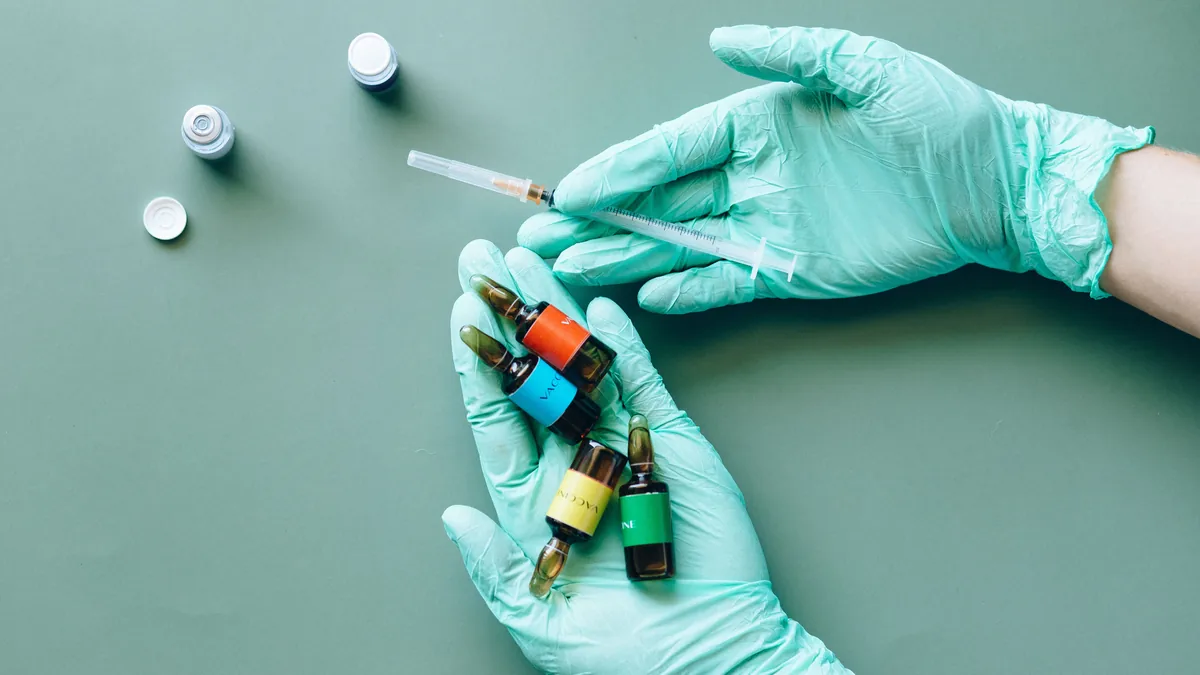
BPC-157 has been studied for building new blood supply into damaged tendons and ligaments. TB-500 has been studied for signaling repair cells to move to the site of structural failure. Both belong only in physician-directed care with lab monitoring.
The tendon that will not settle. The ligament that has been “almost better” for eleven months. The joint that flares whenever you ask anything real of it.
You have probably been told this is a local problem. A bad tendon, a stubborn injury, bad luck. But when a structure does not heal on time, the useful question is not what is wrong with the tissue. It is why the body’s repair system is not reaching it.
Why won’t my tendon heal?
Tissue does not heal by itself. Healing is a team effort. Blood supply has to arrive. Repair cells have to move to the right place. And the area around it has to be calm enough for building to go on.
When any of those steps fails, the tissue looks like the problem. It usually is not. Structural failure is a body-wide breakdown in repair that shows up at the weakest point.
This is where the assembly-line model runs out of tools. It is built to treat the site. Inject it, image it, immobilize it, and in the end cut it. The site is what maps to a visit and a procedure. What it is not built to do is ask why the body’s terrain cannot support repair in the first place. That is a critique of how care is set up, not of the people giving it. But you pay the price: the same tendon, the same year, the same talk.
What is BPC-157 studied for?
BPC-157, or Body Protection Compound, has been studied for its role in building new blood supply. The mechanism is angiogenesis, the growth of tiny new blood vessels. These carry nutrients and oxygen into damaged tendons and ligaments. They also reach the spots where bone meets soft tissue, where healing is famously slow.
That last detail is worth sitting with. Some structures heal poorly for a plain reason: they have a poor blood supply. Tissue that cannot get oxygen and nutrients cannot rebuild, no matter how driven the rest of you is. Anything that addresses delivery is addressing a real limit, not a symptom.
BPC-157 has also been studied for steadying the gut lining. That sounds unrelated to a tendon. But a leaky gut barrier adds to chronic inflammation, called metainflammation. The rest of the body then has to build in that setting. Draining that swamp is not a side quest. It is part of making repair possible.
What is TB-500 studied for?
If BPC-157 is about supply lines, TB-500, or thymosin beta-4, is about logistics.
Its mechanism is adjusting G-actin, a protein that helps cells move. In plain terms, it is studied for telling the body’s repair cells to travel to the site of structural failure. Having repair power is not the same as having repair power in the right place. Movement is how one becomes the other.
TB-500 has also been studied for crossing the blood-brain barrier and calming nerve inflammation. That matters because recovery from structural failure involves the whole body, not just one spot. A nervous system that stays inflamed is part of why some patients stay stuck.
Why do BPC-157 and TB-500 need physician supervision?
BPC-157 and TB-500 are not healing drugs you take on your own. They are not shortcuts. They are compounds studied for specific signaling effects. When they are used at all, it is as physician-directed care.
You will find no dosing on this page. No schedules, no routes, no cycle lengths, no vendors. That absence is deliberate and permanent. These molecules act on blood vessel growth and cell movement. In the wrong setting, you do not want those processes boosted without a physician who knows your history and checks your labs. A patient with an unchecked medical history is exactly the one who should not experiment with growth and blood vessel signals.
The internet’s version of this subject is a protocol. The clinical version is an evaluation. Those are not the same product, and the difference is not paperwork.
What coordinated care actually looks like
The point of repair signaling is not to replace structural treatment. It is to make structural treatment worth doing.
High-precision procedures put the right thing in the right place. They are guided by fluoroscopy (live X-ray) and ultrasound for sub-millimeter accuracy. But a precise injection is still only an instruction. A body that cannot deliver blood or move repair cells to the site cannot carry it out. Order matters. Build the internal setting first. Then the precision work can restore real function instead of a short-lived result.
What comes first for you, and whether signaling support belongs at all, is set by exam, imaging, and lab tests. It is not set by a page you found while searching for your tendon.
At Regen.MD, you start with a Clinical Evaluation with physician review. It is thorough on purpose. Its result is a judgment about whether you are a candidate, not an automatic prescription. Many patients hear that the terrain has to change before anything else makes sense. Some hear that they are not candidates.
The clinic is located at 4477 Woodson Rd, Suite 103, St. Louis, MO 63134, adjacent to St. Louis Lambert International Airport, which makes it accessible to patients traveling in. Phone (314) 295-3000; the text line is (314) 886-5902.
Frequently asked questions
How are BPC-157 and TB-500 provided?
They are provided only as part of physician-directed care with clinical evaluation and monitoring. Anyone selling them as proven, approved treatments for tendon or ligament injury is misstating their status.
For how peptide regulatory status works more broadly, including the February 2026 compounding change, read Peptide Therapy Explained: The Body’s Signaling Software.
Can these peptides replace surgery or an interventional procedure?
That is not the framing. The idea here is order, not swapping one for the other. Address the internal setting so the body can take up a high-precision procedure. Whether you need a procedure, whether signaling support fits, and in what order is a clinical call. It needs imaging and an exam.
Why won’t this page tell me how to use them?
Because explaining a mechanism and handing out a do-it-yourself protocol are different things. Only one belongs on a physician’s website. These compounds affect blood vessel growth and cell movement. That is exactly why they need a physician who knows your full medical history and checks your lab work. Peptides bought and used without supervision are an unmonitored experiment, not a treatment.
The same no-protocol approach applies to Epitalon and GHK-Cu in Biological Aging: Telomeres, Gene Expression, and What Peptides Have Been Studied For.
Should I stop a treatment my current physician recommended?
No. Do not start, stop, or change any treatment without consulting your physician. Nothing here tells you to abandon care. If this raises questions, bring them to the physician managing your case or get a formal second evaluation.
What’s the difference between BPC-157 and TB-500?
BPC-157 is about supply lines. It has been studied for angiogenesis, building tiny blood vessel networks. They carry oxygen and nutrients into damaged tendons, ligaments and the spots where bone meets soft tissue, where healing is slow. TB-500 is about logistics. It has been studied for adjusting G-actin, which signals repair cells to move to the site of structural failure.
Can I take TB-500 every day?
Not on your own. This page gives no doses, schedules or cycle lengths, and that is on purpose. TB-500 acts on cell movement. You do not want that boosted without a physician who knows your history and checks your labs. Whether it belongs in your care at all is decided after a physician-led Clinical Evaluation. A protocol found online does not decide it.
What is the best peptide for tendon repair?
The answer depends on why your tendon is not healing, not on a product. A tendon that will not settle usually reflects a breakdown in the body’s repair system. BPC-157 has been studied for building blood supply into tissue with a poor blood supply. TB-500 has been studied for moving repair cells to the injury. Whether either belongs in your care is decided by exam, imaging and lab work.
Key takeaways
- Lasting structural failure often reflects a breakdown in the body’s repair system, not just damaged local tissue.
- BPC-157 has been studied for angiogenesis, building tiny blood vessels to tendons, ligaments, and the spots where bone meets soft tissue. It has also been studied for steadying the gut lining.
- TB-500 has been studied for adjusting G-actin to help repair cells move, and for calming nerve inflammation.
- Results are not guaranteed and not every patient is a candidate.
- Repair signaling aims to prepare the terrain so precision procedures can hold. It is used under physician direction and monitoring, never on your own.
This article is educational and is not a substitute for evaluation, diagnosis, or treatment by a physician. Individual results vary, and not every patient is a candidate for the therapies described. Do not start, stop, or change any treatment without consulting your physician. Peptide therapies are provided only as part of physician-directed care under ongoing clinical evaluation and laboratory monitoring.
Find out what is actually driving your pain
Regen.MD begins with a physician-led Clinical Evaluation — a review of your history, imaging, and metabolic data, and a written terrain roadmap. Evaluation is contingent upon review of your data.
Questions? Call or text us.