
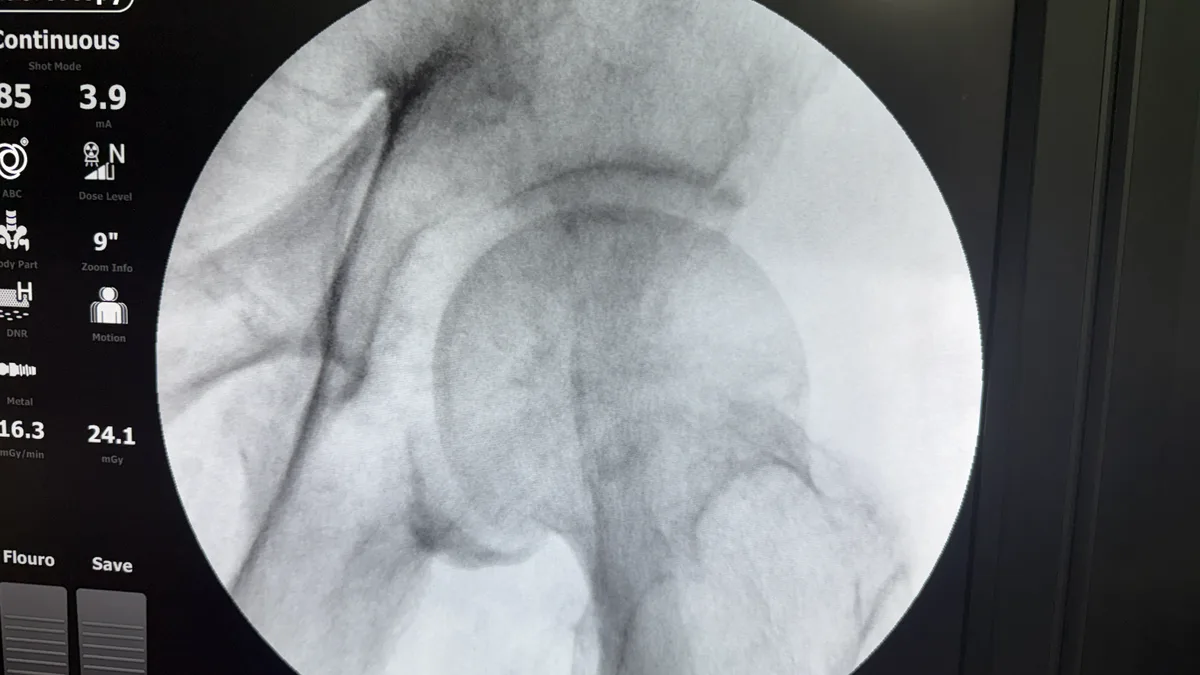
You avoid or delay hip replacement by calming the inflammatory fire inside the joint, then rebuilding the mechanics. The fire is calmed with an orthobiologic ladder: viscosupplementation, then PRP, then BMAC. With BMAC, 69% of hips survive at 10 years, compared with 48% without.
“Minimally invasive” is one of the most soothing phrases in medicine. It suggests a small cut, a short recovery and a light touch.
Here is what it leaves out. To start a hip arthroscopy, the surgeon applies 60 to 80 pounds of traction. That force pulls the ball of your hip out of its socket to make room to work. The cuts are small. The pull needed to make them useful is not minimal by any fair measure.
That pull stretches your femoral nerve, the main nerve to the front of the thigh, to an extreme. And the risks do not stop there.
How long does a hip replacement last?
Say you are in your 30s or 40s and a hip replacement is on the table. Then there is a math problem that should be on the table too.
A new hip has a 15 to 20 year lifespan. Subtract that from your real life expectancy. A replacement at 40 does not end the story. It nearly guarantees a future “replacement of a replacement,” and that second surgery is much harder and has higher complication rates than the first.
So the real question is not whether you will one day need a hip replacement. It is how many you are signing up for. And how much of your own bone will be left when you need the hardest one.
Every year you keep your own joint is a year the clock is not running.
Is hip arthritis just wear and tear?
The main story about arthritis is mechanical. Your cartilage wore out, like a tire or a brake pad, and the only fix is to replace the part.
That framing is a myth, and a costly one, because if the problem is only mechanical, then the only fixes are mechanical. And you are on a conveyor belt to the operating room.
Arthritis is better seen as a fire of inflammation inside the joint. It is an active biological process, not a passive pile-up of mileage. That difference changes everything about what can be done, because active processes can be influenced. You cannot un-wear a tire. You can put water on a fire.
What are the non-surgical alternatives to hip replacement?
There is not one regenerative treatment for hips. There is a ladder. You climb it to match your condition, not as one plan for all.
Viscosupplementation sits at the first rung. PRP at the second. Bone marrow aspirate concentrate (BMAC) at the third, for conditions that call for it. The right rung depends on your imaging, your exam and your metabolic picture. It is not picked from a menu.
On how long it lasts, the BMAC data are worth stating exactly. BMAC-augmented repair shows superior function at five years — and that function improves over time. That is the opposite of what patients are trained to expect from an injection.
The survival figure is the one to hold onto: 69% joint survival at 10 years, compared with just 48% without. That is a big difference in how many people still have their own hip ten years later.
Why calm the inflammation before rehab?
Here is the part that reframes the whole decision. Calming the fire is not the end point. It is what makes the end point possible.
Once the fire is calmed, rehab can finally do its job. It can address the movement patterns and mechanical root causes that were wearing down the joint in the first place. Pain is what stops you from loading the joint well. Remove enough of it, and the corrective work opens up to you.
That is why this is not a “wait and see” plan. Waiting is passive. The joint keeps breaking down while you put up with it. This is an active sequence: calm the biology, then rebuild the mechanics, in that order.
You are not a line item in a high-volume system. You have a window when your own joint can still be saved. That window does not stay open forever.
For more information, get our free guide to knee pain and treatment options.
Frequently asked questions
Is hip replacement ever the right choice?
Yes. For some hips, it is an excellent operation. That is most true in older patients, where the new hip will likely outlast the need. The concern here is narrow. Recommending it early, in someone in their 30s or 40s, locks them into a cycle of repeat surgeries before anyone has seriously tried to save the joint.
What makes hip arthroscopy riskier than it sounds?
The access itself. It takes sixty to eighty pounds of traction to pull the joint open enough to work in it. That stretches the femoral nerve to an extreme. “Minimally invasive” describes the size of the cut, not the forces put on your body during the procedure.
Should I cancel surgery my orthopedic surgeon recommended?
Do not start, stop, or change any treatment without consulting your physician. Raise these questions with your surgeon, or seek a formal second evaluation before the date. Nothing here is a directive to abandon care your own doctor has recommended.
How do I know which orthobiologic option applies to my hip?
That is a clinical call, not one you make for yourself. The ladder runs from viscosupplementation to PRP to BMAC, matched to your condition. Getting the match right takes imaging, an exam and a metabolic check. Individual results vary, and not everyone is a candidate.
Can hip replacement be avoided?
The goal is to avoid it or delay it on your own timeline. You do that by calming the fire inside the joint with an orthobiologic ladder: viscosupplementation, then PRP, then BMAC. Then you rebuild the mechanics with rehab. In the BMAC data, 69% of hips were still the patient’s own at 10 years, compared with 48% without it. Individual results vary.
Can exercise or physical therapy help you avoid a hip replacement?
Yes, but the order matters. Pain is what stops you from loading the joint well, so rehab struggles while the joint is inflamed. Once the fire is calmed, rehab can fix the movement patterns and mechanical root causes that were wearing down the joint. Calm the biology first, then rebuild the mechanics.
Why is a hip replacement at 40 a concern?
A new hip has a 15 to 20 year lifespan. A replacement at 40 nearly guarantees a future replacement of the replacement. That redo surgery is much harder and has higher complication rates than the first one. So the real question is how many hip surgeries you are signing up for. And how much of your own bone will be left for the hardest one.
What happens if I just wait and see with hip arthritis?
Waiting is passive. The joint keeps breaking down while you put up with the pain. The window when your own joint can still be saved does not stay open forever. Every year you keep your own hip is a year the clock on a new hip is not running. That matters most if you are in your 30s or 40s.
Key takeaways
- Hip arthroscopy takes 60 to 80 pounds of traction to pull the ball of the hip from the socket. That stretches the femoral nerve to an extreme.
- A new hip lasts 15 to 20 years. So a replacement in your 30s or 40s nearly guarantees a harder, riskier redo later.
- Arthritis is an inflammatory process, not simple wear and tear. That means it can be influenced, not only replaced.
- Orthobiologic care steps up through viscosupplementation, PRP, and BMAC. BMAC-augmented repair shows superior five-year function that improves over time.
- Joint survival reaches 69% at 10 years with this approach versus 48% without. And calming the inflammation is what lets rehab fix the root cause.
This article is educational and is not a substitute for evaluation, diagnosis, or treatment by a physician. Individual results vary, and not every patient is a candidate for the therapies described. Do not start, stop, or change any treatment without consulting your physician.
Find out what is actually driving your pain
Regen.MD begins with a physician-led Clinical Evaluation — a review of your history, imaging, and metabolic data, and a written terrain roadmap. Evaluation is contingent upon review of your data.
Questions? Call or text us.
Sources
- Evans JT, Evans JP, Walker RW, et al. How long does a hip replacement last? A systematic review and meta-analysis of case series and national registry reports with more than 15 years of follow-up. Lancet, 2019. PubMed 30782340 · doi:10.1016/S0140-6736(18)31665-9
- D’Souza RS, Her YF, Hussain N, et al. Evidence-Based Clinical Practice Guidelines on Regenerative Medicine Treatment for Chronic Pain: A Consensus Report from a Multispecialty Working Group. J Pain Res, 2024. PubMed 39282657 · doi:10.2147/JPR.S480559