
Sit to stand exercise · Knee pain · St. Louis · Regen.MD physiotherapy
Sit to stand exercise:
practice the move you make all day
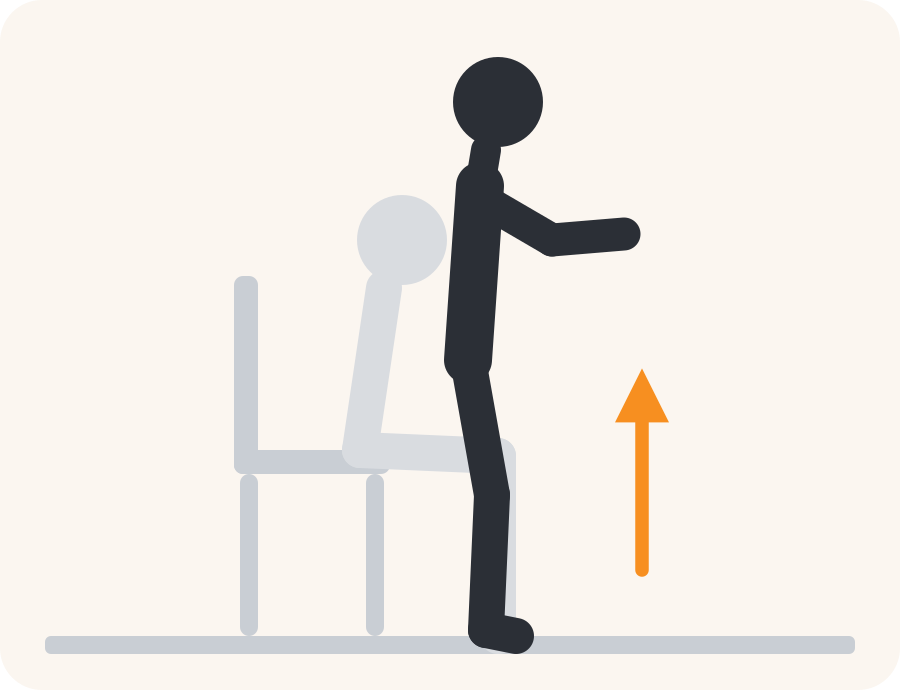
Sit to stand is a home exercise that trains leg strength and balance through the act of rising from a seat. Perched near the front of a solid chair, feet planted hip-width, rise to standing, leaning on your hands only when needed, then lower yourself back down with control. Ten in all.
Only the exercises your physician has ticked on your home plan are yours to do. Twice daily is the rhythm unless the written plan says something different.
Step by step: sit to stand exercise
- Starting position. Perch toward the front edge of a solid chair, feet planted hip-width.
- The motion. Rise to standing, leaning on your hands only when needed. Return to the seat with control.
- How much. Controlled tempo, ten in all.
What the sit to stand does for tissue repair
Standing up from a seat is one of the heaviest loads most people put on their knees each day. Training it on purpose is the most direct way to bring normal load back to a knee after treatment, a little at a time.
Fresh from an injection? Read this first
After a PRP or other orthobiologic injection in your knee, the treated tissue needs a protected stretch of days before it is asked to work. Your physician tells you when this exercise comes back. When it does, start with fewer repetitions and build to the full dose over the following visits. Loading in steps like this is how the repair signal from the injection turns into stronger tissue.
More on that: why load is the treatment an injection cannot supply.
Form errors we correct most often
- Knees drifting inward.
- Collapsing into the seat instead of lowering.
- Throwing your weight far over your toes.
Signs that mean stop and phone us
Feeling the muscle work, a gentle pull, or some next-day stiffness is normal. Call us at (314) 295-3000 if you notice:
- Pain that turns sharp or stabbing
- A pain score that climbs 2 or more points and stays up longer than an hour
- New numbness, tingling or loss of strength
- Feeling dizzy, or your eyesight changing
Call 911, not the clinic, for chest pain, a hard time breathing or passing out.
Tracking what changes
Keep a short log: a check mark for each session and one pain score per day. Hand it over at each appointment; your technician tallies the sessions and has you perform one repetition so your form can be corrected. At each re-check you also repeat the same function questionnaire, and if your physician orders it, a Kinetisense 3D motion scan, so the change is measured instead of guessed.
What to remember
- Knees track the second toe.
- Lower slowly; no collapsing.
- Hands are a backup, not the engine.
Show us you have it: Before you go, stand up and sit down twice for us so we can watch your knees. If a point is fuzzy, say so and we walk through it again with you.
The rest of the knee series
- Thigh squeeze (quad set): thigh switch-on
- Straight leg raise: thigh strength, knee straight
- Heel slide: knee bend
Related reading: PRP knee injection in St. Louis, why knee pain comes back after therapy.
Where this fits: the Regen.MD physiotherapy program, physician-directed rehab paired with our regenerative care. A physician must be in the building and reachable within moments before any treatment begins.