
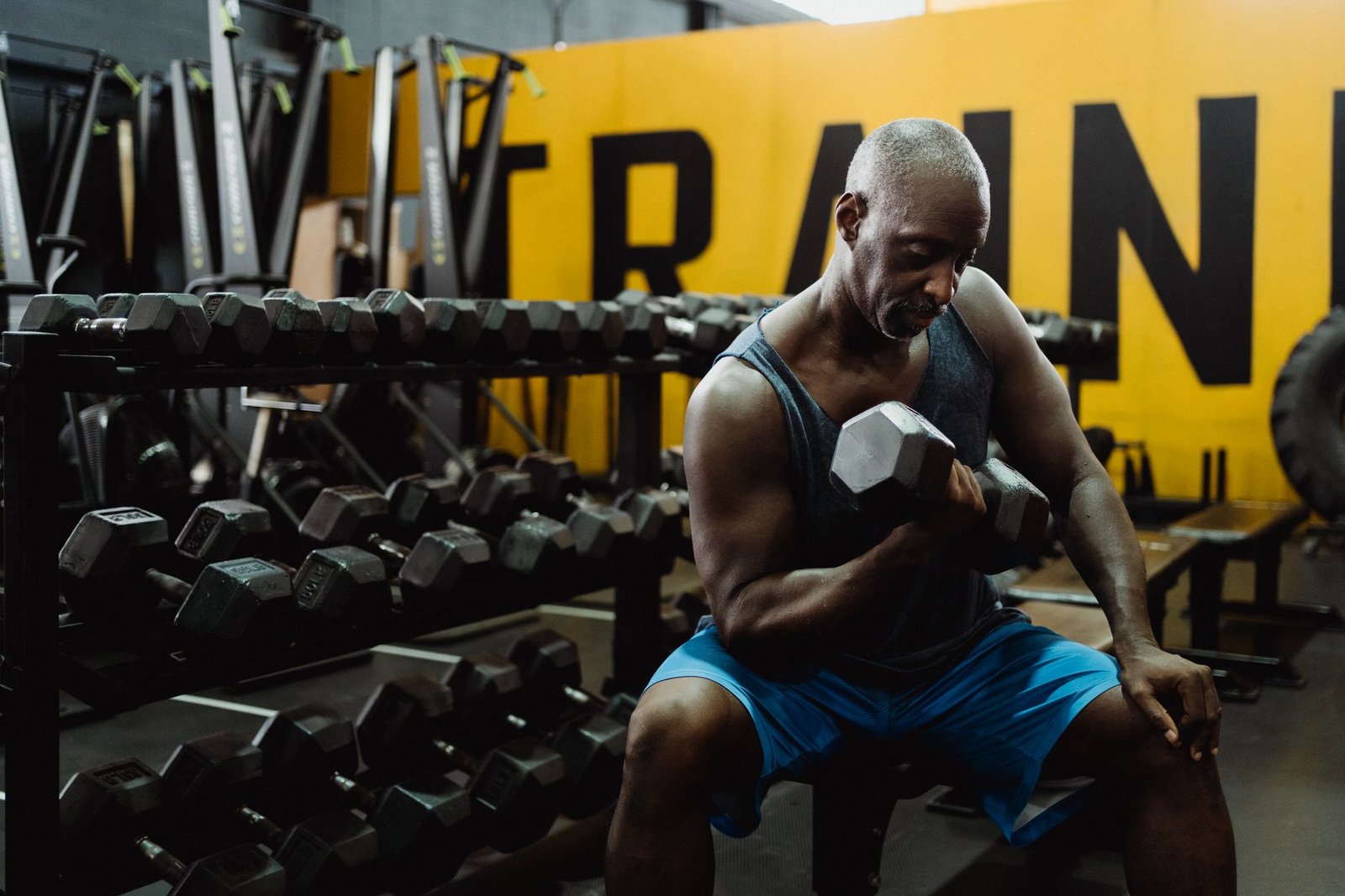
Returning to load after an injury is the treatment, not the aftercare. New collagen lines up along the direction of load, and no injection supplies that signal. The load has to build step by step and keep going for months past the point where it stops hurting.
Patients arrive expecting to talk about which injection. The most important thing said in that visit is usually about load, and it lands badly. Load sounds like the advice from everyone who has already failed to help.
The difference is what it is being prescribed as. Not fitness. Not general conditioning. A biological signal, with a dose, aimed at a specific mechanism.
How does exercise help an injury heal?
Connective tissue cells sense force. Tenocytes, chondrocytes and fibroblasts feel strain through their cell membranes and inner scaffolding (cytoskeleton). They turn it into changes in which genes switch on. That controls how much new matrix gets made, how it is cross-linked, and which way new fibers are laid down. Mechanical strain is not an add-on to remodeling. It is one of its inputs.
That is why repair stalls in an unloaded limb during the remodeling phase. Type III collagen is being replaced by type I, and the direction of load sets how the new fibers line up. Remove load and the tissue still remodels. But it lays down a random, weaker pattern, because nothing told it which way to point. That is a structural flaw caused by an instruction that was never sent, and no catalyst supplies it. The failure is described in why some injuries never finish healing.
The ten-year result that makes this concrete
A randomized trial enrolled 140 people with a degenerative meniscal tear and little or no arthritis on X-ray. They got either arthroscopic partial meniscectomy or twelve weeks of exercise therapy. At ten years, X-ray arthritis had developed in 23% of the surgery group and 20% of the exercise group. There was no clinically relevant difference in reported pain, knee function or isokinetic muscle strength.
Two honest limits. It studied degenerative tears, not injury tears, and it is one trial. It does not prove that surgery is useless. It shows that in this group, over a decade, changing how the joint was loaded worked as well as changing the joint's anatomy. Twelve weeks of it.
What is the best exercise program after an injury?
A 2026 systematic review and network meta-analysis of exercise for patellar tendinopathy included seventeen randomized trials. Its main connected network held ten studies and 313 people. No method was statistically better than heavy slow resistance training. The authors warn that the probability-based rankings are exploratory, not proof that one method is truly better.
That reads like a negative result, but it is not one. If eccentric overload, blood flow restriction, moderate slow resistance and heavy slow resistance work about the same, the active ingredient is not the program. It is progressive mechanical load, at a dose the tissue can adapt to, for long enough. That removes the most common excuse for not doing it: that the right program has not been found yet.
When do most people stop rehab after an injury, and why is it too soon?
Almost universally, at the point where it stops hurting.
Pain goes away before strength and control come back. Look at the pooled data on first-time outer ankle sprains. Leftover pain had dropped to 6.7% at twelve months. But 15.8% had already sprained the ankle again within that year. That re-injury rate is more than twice the leftover pain rate. People were not re-injuring painful ankles. They were re-injuring comfortable ones that still lacked strength and joint position sense (proprioception).
That gap between comfort and capacity is the whole case for continuing months past the point where it feels finished.
Load is also a terrain intervention
This is the part that ties it to everything else on this site. Working muscle acts as a hormone organ. It releases myokines, improves insulin sensitivity, and changes the whole-body inflammation the repair runs in. Progressive resistance training is two things at once. It is the mechanical signal to the healing tissue. And it is one of the more reliable ways to change the metabolic state that decides whether the tissue can act on that signal.
One treatment, two mechanisms, and it is the only item on the plan that does both. Everything else (the biologic, the medicine, the vitamin and mineral fix) does one thing. That is why it is prescribed as seriously as a procedure, not handed over as advice at the end of a visit. The metabolic side is covered in You Cannot Out-Inject a Broken Metabolism.
Should you exercise before or after a regenerative injection?
Loading starts first and does not stop. Where a stalled repair is confirmed and the terrain has been addressed, a catalyst goes into tissue that is already getting the mechanical instruction it needs. That is the correct order. It is also the order the guideline documents describe when they place regenerative therapy alongside structured exercise, not instead of it.
An injection into an unloaded limb is a signal sent to a workforce with no blueprint.
Frequently Asked Questions
Is exercise really as good as a procedure?
For some problems the randomized answer is yes, over the long run. In a degenerative meniscal tear trial, twelve weeks of exercise therapy matched arthroscopic partial meniscectomy at ten years on X-ray progression, symptoms and strength. What that does and does not settle about a torn meniscus is covered in Is Meniscus Surgery Worth It?.
Which loading protocol is best?
In the 2026 network meta-analysis for patellar tendinopathy, no exercise method clearly beat heavy slow resistance training. The authors themselves warn that the rankings are exploratory. So the program matters less than the progression being real. How that is set up after a procedure is in Returning to resistance training after an orthobiologic procedure.
How long should loading continue after the pain stops?
Months past that point. Pain goes away before capacity returns, and stopping at comfort leaves the weakness that becomes the next injury. Realistic timelines are set out in Realistic recovery timelines after orthobiologic treatment.
Do I need protein or supplements for this to work?
Enough protein, and the lifting that puts it to use, are the two inputs that actually change muscle mass. Neither is optional for an adult rebuilding after an injury. The practical version is in Protein intake and resistance training to protect muscle as you age.
Will loading make my injury worse?
Progressive loading and re-injury are different things. Telling them apart is a clinical judgment about dose, not a rule about avoidance. That is why the program is prescribed and reviewed, not handed out. Where a procedure is the wrong next step entirely is discussed in When orthobiologics are not the right treatment.
How do you start exercising after an injury?
Start with a load the tissue can adapt to, then raise it step by step. The exact program matters less than people think. In patellar tendon trials, several methods did about as well as heavy slow resistance training. What matters is that the load builds and continues for months. The dose is a clinical judgment, which is why the program is prescribed and reviewed, not handed out.
Why do injuries come back after the pain is gone?
Because pain fades before strength and control return. After a first ankle sprain, only 6.7% still had pain at twelve months. Yet 15.8% had already sprained the same ankle again within that year. They were re-injuring ankles that felt fine but were still weak. That gap between feeling fine and being capable is why loading continues well past the point it stops hurting.
Does strength training help beyond the injured area?
Yes. Working muscle acts like a gland. It releases signaling molecules called myokines, improves insulin sensitivity and changes inflammation across the whole body. So resistance training does two jobs at once. It sends the mechanical signal the healing tissue needs. And it improves the metabolic state that decides whether the tissue can respond. No other part of the plan does both.
Find out what your recovery is actually limited by
Regen.MD begins with a physician-led Clinical Evaluation — a review of your history, your imaging and your metabolic data, and a written terrain roadmap before any procedure is discussed. Evaluation is contingent upon review of your data.
Questions? Call or text us.
Sources
- Berg B, Roos EM, Englund M, et al. Arthroscopic partial meniscectomy versus exercise therapy for degenerative meniscal tears: 10-year follow-up of the OMEX randomised controlled trial. Br J Sports Med, 2025. PubMed 39326908 doi:10.1136/bjsports-2024-108644
- Liu Y, Li C, Yang F. Comparative effectiveness of exercise interventions for patellar tendinopathy: a systematic review and network meta-analysis of randomized controlled trials. BMC Sports Sci Med Rehabil, 2026. PubMed 42192475 doi:10.1186/s13102-026-01743-4
- Kon E, Di Matteo B, Delgado D, et al. Platelet-rich plasma injections for the management of knee osteoarthritis: the ESSKA-ICRS consensus. Recommendations using the RAND/UCLA appropriateness method for different clinical scenarios. Knee Surg Sports Traumatol Arthrosc, 2024. PubMed 38961773 doi:10.1002/ksa.12320
- Manchikanti L, Navani R, Navani A, et al. Comprehensive evidence-based guidelines for regenerative therapies in the management of chronic low back pain: 2025 update from the American Society of Interventional Pain Physicians (ASIPP). Pain Physician, 2025. PubMed 41481869
- D'Souza RS, Her YF, Hussain N, et al. Evidence-based clinical practice guidelines on regenerative medicine treatment for chronic pain: a consensus report from a multispecialty working group. J Pain Res, 2024. PubMed 39282657 doi:10.2147/JPR.S480559
- Michels F, Wastyn H, Pottel H, Stockmans F. The presence of persistent symptoms 12 months following a first lateral ankle sprain: a systematic review and meta-analysis. Foot Ankle Surg, 2022. PubMed 34961654 doi:10.1016/j.fas.2021.12.002
- Leong HT, Fu SC, He X, et al. Risk factors for rotator cuff tendinopathy: a systematic review and meta-analysis. J Rehabil Med, 2019. PubMed 31489438 doi:10.2340/16501977-2598