
Platelet-rich plasma is not one treatment with one set of proof. Where the platelets go matters. A tendon or a joint space changes the trial designs, what gets measured, and the results. The clearest proof is this. Level I evidence (the strongest kind) supports PRP in rotator cuff tendon problems and tears. Yet conflicting level I evidence argues against it in kneecap and Achilles tendon problems and tears [1].
Both of those are tendon targets. If the evidence splits that sharply within one tissue type, a general claim that “PRP works” cannot hold up against a specific diagnosis.
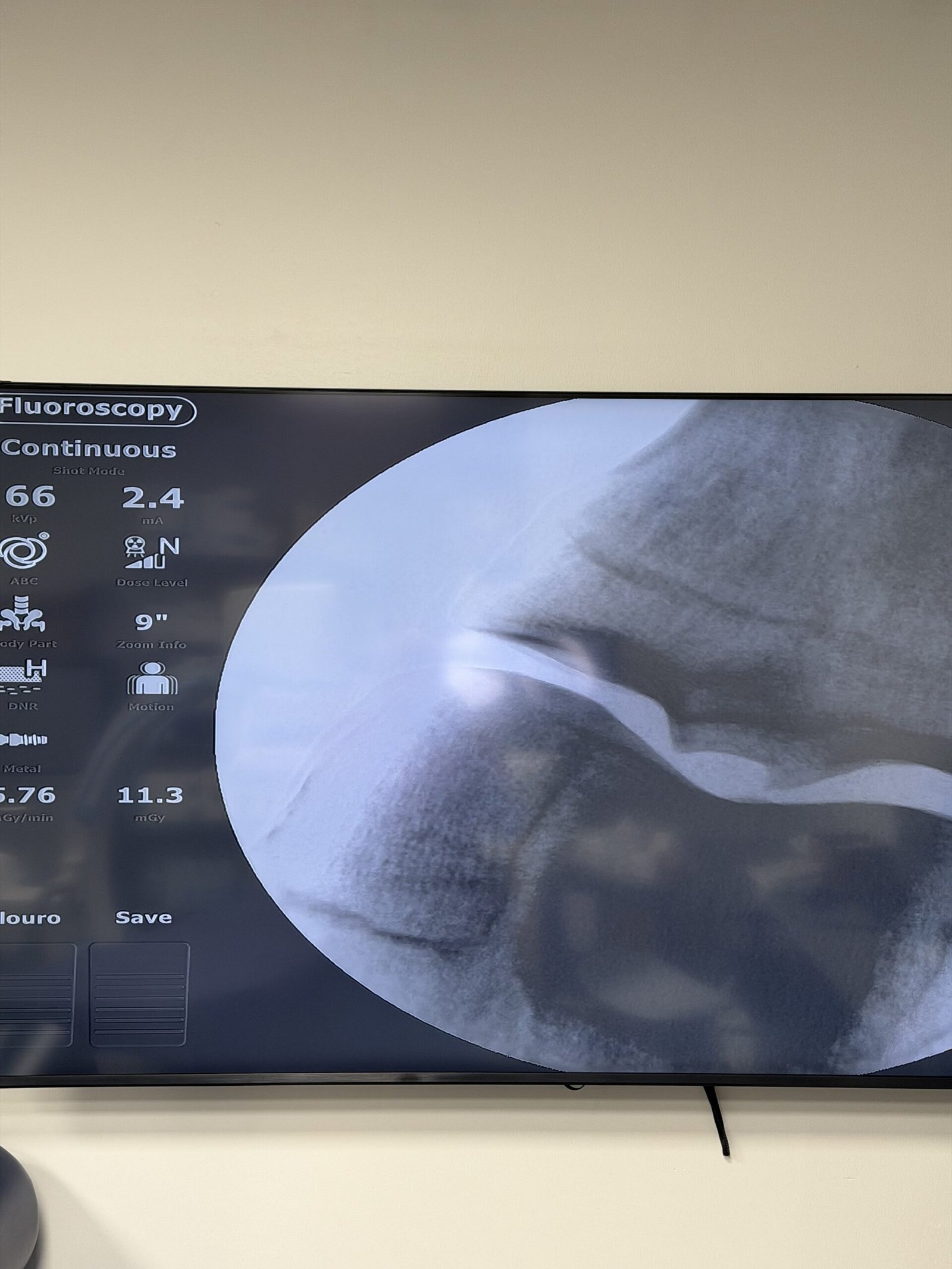
Why the target changes the question
Tendon targets
A tendon shot is aimed at the tendon itself and where it joins the bone. The idea is that the problem comes from repeated load and built-up tiny damage. Those trials usually measure a pain score and a function score for that limb. They check them at short, middle, and long follow-up.
Joint-space targets
A shot into the joint is aimed at the joint space. There, irritated joint lining, the joint fluid, and mechanical factors inside the joint add to symptoms. Different tissue, different cause, different measures — so it has its own set of proof. It should not be read across from the tendon studies.
Look across bone, joint and muscle care as a whole. Strong evidence has been reported for PRP in several conditions. The list is long. It covers osteoarthritis, epicondylitis, bursitis, compressive neuropathy, plantar fasciitis, muscle injuries, and osteochondral lesions [1]. The same review notes there is little research on spine and hand conditions. It also says the overall evidence keeps producing conflicting results [1].
How effective is PRP for tendonitis?
Rotator cuff
A 2025 review compared PRP with a steroid shot across tendon problems. Short-term pain and function improved more after PRP in rotator cuff tendon problems. But that effect did not last long-term [2]. A separate 2025 review pooled 27 randomized controlled trials. They held 1,779 patients. In rotator cuff injury, it found no group difference in pain or function at one month. At three months, the pain score improved more with PRP (OR −1.64, 95% CI −2.97 to −0.31, p = 0.02) [3].
Lateral epicondylitis and gluteal tendinopathy
The same 2025 review found PRP worked longer than steroids in hip (gluteal) tendon problems and tennis elbow. It did not work better in the short term [2]. That is the reverse of the rotator cuff pattern, in the same review, from the same comparison.
Plantar fasciitis and tenosynovitis
Now look at heel pain. In the 27-trial study, patients with plantar fasciitis showed no significant gap between PRP and steroid at one and three months. That held for pain and for AOFAS foot scores. But at six months, the PRP group scored significantly better on both [3]. Then there is tenosynovitis, an inflamed tendon sheath. There, the pain score was lower in the steroid group at one month. It was better in the PRP group at six months (OR −0.72, 95% CI −1.04 to −0.40, p < 0.00001) [3].
The authors summed it up this way. For tendon problems, PRP beats steroid over the middle term. Long-term results still need to be proven in practice [3].
Does the tendon PRP evidence apply to knee arthritis?
Patients who ask about an alternative to knee replacement are asking a joint question, not a tendon one. The tendon results above do not carry over to it. For advanced knee osteoarthritis, platelet-rich plasma is framed the way the trial authors framed it: as a safe bridge therapy before joint replacement.
No orthobiologic offered at our orthobiologics service is claimed to regrow or regenerate cartilage. Where a patient is on that timeline, and whether a bridge would even help them, is a medical call, not a marketing one.
How do we choose where the PRP goes?
Three questions come first. Which structure is most likely driving the pain now? What has already been tried, and for how long? What timeline for results is fair for that specific target? Only after those are answered does the choice matter. The choice is among PRP, shots into the bone under the cartilage, bone marrow aspirate concentrate, and Lipogems.
Our terrain-first approach adds a fourth question. What is the metabolic setting the tissue must repair in? That affects the response to any biologic, no matter where it is placed.
Frequently asked questions
Is PRP better for a tendon or for a joint?
That question has no single answer. The trials are run separately by body site, and they report different results. Level I evidence supports PRP in rotator cuff tendon problems and tears. Conflicting level I evidence argues against it in kneecap and Achilles tendon problems and tears. So the site matters more than the category. Which target fits you is decided at the exam, as described on our joint dysfunction page.
How long after a PRP injection should a difference be expected?
In the pooled comparison against steroid, differences showed up at different times by condition. It was three months in rotator cuff injury, and six months in plantar fasciitis and tenosynovitis. The authors state that long-term results still need to be proven. How to read trial results instead of headlines is covered in the Regen.MD library.
Does PRP rebuild cartilage in an arthritic knee?
No. For advanced knee osteoarthritis, PRP is framed the way the trial authors framed it — as a safe bridge therapy before joint replacement. No orthobiologic offered here is claimed to regrow or regenerate cartilage. Those points are reviewed at the evaluation by Dr. Gurpreet Singh Padda, MD, MBA, MHP.
What if both a tendon and a joint are involved?
Mixed problems are common in the shoulder, elbow, hip, and knee. The aim is to find which structure is the main driver now, not to inject everything at once. That is decided in person at our St. Louis clinic.
Is PRP better than a cortisone shot for tendonitis?
It depends on the tendon and on when you measure. In rotator cuff tendon problems, PRP helped short-term pain and function more than a steroid shot. But the effect did not last. In tennis elbow and hip tendon problems the pattern flipped, with PRP showing the longer-term edge. Across 27 randomized trials, the authors concluded that PRP’s middle-term results beat steroid in tendon problems. Long-term results are still to be proven.
Key takeaways
- Level I evidence supports PRP in rotator cuff tendon problems and tears. Conflicting level I evidence argues against it in kneecap and Achilles tendon problems and tears. Both are tendon targets.
- Tendon shots and joint-space shots are studied separately, with different measures. Results do not carry over between them.
- In 27 randomized trials covering 1,779 patients, PRP beat steroid at three months in rotator cuff injury. It won at six months in plantar fasciitis and tenosynovitis. Long-term results are still unproven.
- In tennis elbow and hip tendon problems the pattern flips. PRP showed a longer-term edge over steroid, not a short-term one.
- For advanced knee osteoarthritis, PRP is a bridge therapy before joint replacement. No orthobiologic here is claimed to rebuild lost cartilage.
This article is educational and is not a substitute for evaluation, diagnosis, or treatment by a physician. Individual results vary, and not every patient is a candidate for the therapies described. Do not start, stop, or change any treatment without consulting your physician.
Find out what is actually driving your pain
Regen.MD begins with a physician-led Clinical Evaluation — a review of your history, imaging, and metabolic data, and a written terrain roadmap. Evaluation is contingent upon review of your data.
Questions? Call or text us.
Sources
- Pretorius J, et al. “Current Status and Advancements in Platelet-Rich Plasma Therapy.” Cureus, 2023;15(10):e47176. https://pmc.ncbi.nlm.nih.gov/articles/PMC10652151/
- Modi K, Jain Y, Shah R, Ranga R. “Evaluating Efficacy of Platelet-Rich Plasma versus Corticosteroids in Management of Tendinopathies.” Georgetown Medical Review, 2025;9(1). https://doi.org/10.52504/001c.141338
- Ye X, Yuan Y, Kuang X, Qiu H, Tan L, et al. “Platelet-rich plasma and corticosteroid injection for tendinopathy: a systematic review and meta-analysis.” BMC Musculoskeletal Disorders, 2025. https://pubmed.ncbi.nlm.nih.gov/40200209/