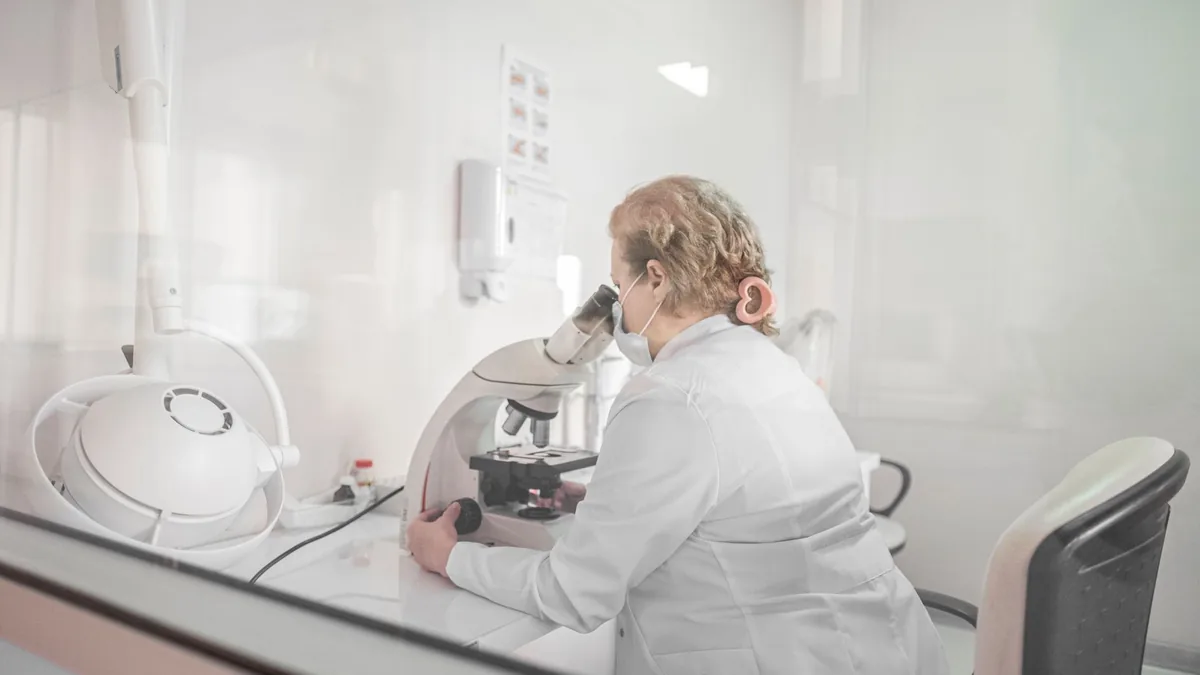
Micro-fragmented adipose tissue is your own fat. It is taken through a small skin cut under local numbing. Then it is broken down by mechanical force into much smaller clusters and injected back. The Lipogems system is the device most linked to that approach.
Two things set it apart from ordinary fat grafting. The pieces that come out are far smaller, and no enzymes are used to get there. What it is not is a way to rebuild cartilage that is already gone.
What is micro-fragmented adipose tissue?
Fat processing has long relied on enzymes to break tissue down and free single cells or cell clusters. Enzymes raise cost and bring safety and effectiveness questions. So research groups built ways to separate fat without enzymes. They use shear, spinning, radiation and pressure instead. Mechanical processing replaces the enzymes [1].
The Lipogems system, first developed by Dr. Carlo Tremolada, is one of those systems. Its stated main goal was to improve on the traditional Coleman fat grafting technique. It does this by making smaller fat clusters for transplant [1].
How does Lipogems process your fat?
Here is the procedure as published. A small skin cut is made under local numbing, and Klein solution is injected into the fat under the skin. The fat is collected and then processed inside the device. There, only mild mechanical forces slowly shrink the clusters, while oil and blood drain into a bag. The whole procedure runs fully submerged in fluid inside the system, to keep handling of the tissue to a minimum [1].
The size change is the point. Clusters shrink from round pieces about 1 to 3.5 mm across down to clusters of 0.2 to 0.8 mm. About 100 to 130 mL of collected fat can be processed into about 60 to 100 mL of final product, using the standard 225 mL kit [1].
Why is fat used as the source?
Fat is studied as a source of mesenchymal stromal cells because it yields a lot and is easy to reach. A 2025 narrative review reports that one gram of fat can provide about 5,000 stem cells. That is roughly 500 times the yield credited to bone marrow [1].
That is a claim about lab yield from tissue samples, not about results in patients. More cells in the vial is not the same as a better result in the joint. It should not be read that way.
What is and is not being claimed
Micro-fragmented adipose tissue is a tissue-processing method with a well-described mechanical procedure. Beyond that, the clinical picture is less settled than the marketing around fat products usually suggests.
At Regen.MD, no orthobiologic is presented as a way to rebuild lost cartilage. For advanced knee osteoarthritis, an orthobiologic is framed as a bridge therapy prior to joint replacement. It may buy function and time in a planned path. It is not a substitute for the operation when the operation is what the joint needs.
How it compares with the other orthobiologics we offer
The starting material is the difference that matters. Platelet-rich plasma comes from your blood. Bone marrow aspirate concentrate comes from your marrow. Micro-fragmented adipose tissue comes from your fat. They are prepared differently, delivered differently, and suited to different targets.
Our orthobiologics service page sets out the full range. It covers joint and tendon platelet-rich plasma in leukocyte-poor and leukocyte-rich types, intraosseous and subchondral platelet-rich plasma, bone marrow aspirate concentrate, Lipogems, and intradiscal orthobiologics. Which one we discuss for you follows from the diagnosis, not from which one you read about first.
Where this fits in care at Regen.MD
At Regen.MD in St. Louis, nothing is scheduled from a phone call. Our conservative-first evaluation starts with your history, symptom timeline, exam findings and current imaging. Then it decides whether an orthobiologic has a sound role at all.
When conservative care has run out, surgery is part of the path, not a failure of it. Dr. Gurpreet Singh Padda, MD, MBA, MHP is a surgeon, and the practice provides surgery at that stage. It is not where we start.
For more information, get our free guide to knee pain and treatment options.
Find out whether an orthobiologic has a role in your case
Regen.MD begins with a physician-led Clinical Evaluation — a review of your history, imaging, and metabolic data, and a written roadmap for what to do next. Evaluation is contingent upon review of your data.
Questions? Call or text us.
Regen.MD, 4477 Woodson Rd, Suite 103, St. Louis, MO 63134, next to St. Louis Lambert International Airport.
Frequently asked questions
Is micro-fragmented adipose tissue the same as platelet-rich plasma?
No. Micro-fragmented adipose tissue is made from your own fat and given as small tissue clusters. Platelet-rich plasma is made from your own blood. They are different starting materials with different handling. Which one fits depends on the tissue being treated. We compare them against your diagnosis when we evaluate the conditions we treat.
What does ‘micro-fragmented’ actually mean?
It refers to the size of the fat clusters after processing. In the published description, mild mechanical forces slowly shrink the tissue. Round clusters of 1 to 3.5 mm across become clusters of 0.2 to 0.8 mm. Our education library covers how that compares with older fat grafting technique.
Will this rebuild the cartilage in my knee?
No. Nothing offered here is claimed to rebuild lost cartilage. For advanced knee osteoarthritis, orthobiologics are discussed as a bridge therapy before joint replacement. That framing is set out on our orthobiologics page.
How do I find out whether I am a candidate?
Through a physician-led Clinical Evaluation. Your history, exam and imaging are reviewed before any procedure is discussed as an option. That review is done by Dr. Gurpreet Singh Padda, MD, MBA, MHP. He is also a surgeon, and he will say plainly when surgery is the better answer.
What is the Lipogems procedure?
It uses your own fat. Fat is taken through a small skin cut under local numbing. Then it is processed inside the Lipogems device. Mild mechanical forces break it into much smaller clusters while oil and blood drain away. No enzymes are used. The clusters shrink from about 1 to 3.5 mm down to 0.2 to 0.8 mm, and the processed tissue is injected back.
Does Lipogems really work?
It is a well-described way to process fat. But the clinical picture is less settled than the marketing around fat products suggests. It is not a way to rebuild lost cartilage. For advanced knee osteoarthritis it is framed as a bridge therapy before joint replacement, something that may buy function and time. Whether it has a sound role for you is decided at a Clinical Evaluation.
Sources
- Fu H, Wang C. “Micro-fragmented adipose tissue — An innovative therapeutic approach: A narrative review.” Medicine, 2025. https://pmc.ncbi.nlm.nih.gov/articles/PMC11875617/ — referenced for the shift from enzymatic to non-enzymatic mechanical separation, the origin and stated goal of the Lipogems system, the procedural description (minor skin incision under local anesthesia, Klein solution, mild mechanical forces, drain bag, fully submerged system), the cluster size reduction from 1 to 3.5 mm down to 0.2 to 0.8 mm, the 100 to 130 mL input and 60 to 100 mL output using the 225 mL kit, and the approximately 5,000 stem cells per gram of adipose tissue figure.