
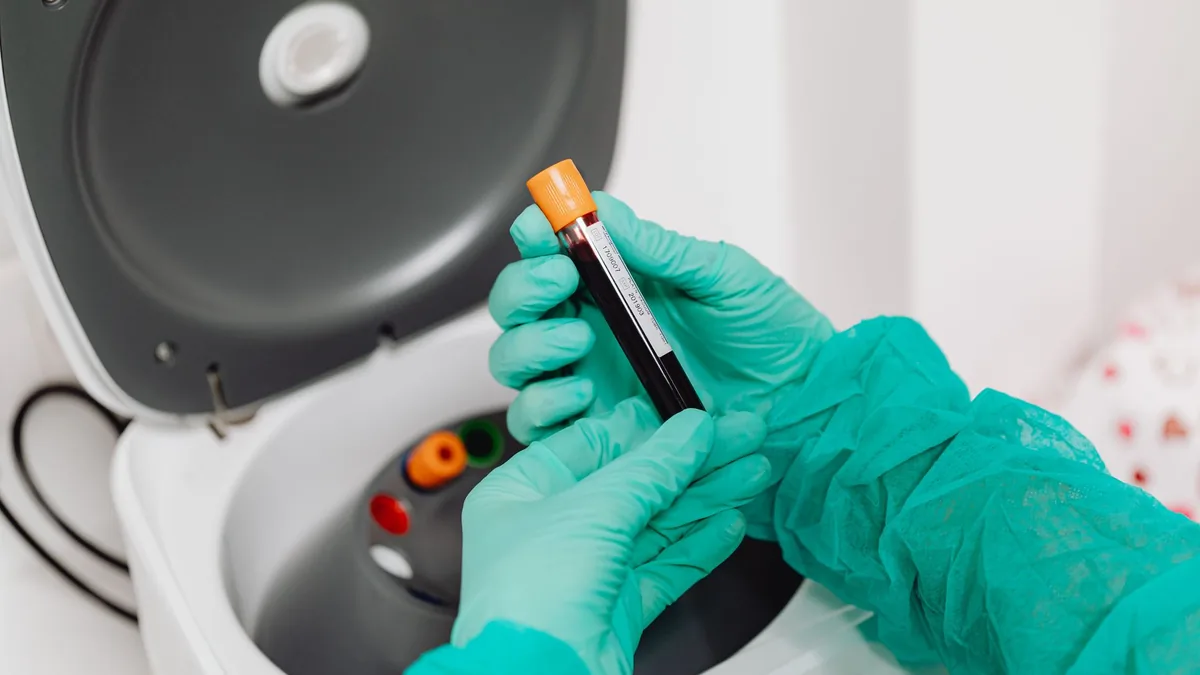
Bone marrow aspirate concentrate is an autologous preparation. That means marrow drawn from your own body, concentrated, and injected at a target. It is not a settled treatment with proven long-term superiority. It does not regrow or regenerate cartilage. A 2025 narrative review in Medicina (Kaunas) looked at BMAC for knee osteoarthritis. It reports short- to mid-term symptom relief and better function. It also reports mixed findings. Long-term results against other options are not yet firmly established.
What is bone marrow aspirate concentrate (BMAC)?
An autologous concentrate, prepared from your own marrow
BMAC starts with a marrow draw. The marrow is then concentrated before it is injected. The starting material comes from the patient. So it is in a different class from anything made from donor tissue.
The 2025 narrative review describes BMAC as rich in mesenchymal stem cells and bioactive growth factors. It discusses proposed effects on inflammation. It also discusses proposed effects on subchondral bone remodeling (how the bone under the cartilage reshapes itself).
Mechanism language is not outcome language
This point matters more than any other in this article. A review can describe what a preparation contains and what it is thought to do in the body. That is not the same as showing what it does for a patient over years.
Regen.MD keeps those two apart on purpose. You can see how that shapes the wider plan in the Regen.MD approach to terrain-first care.
What does BMAC not do?
It does not regrow or regenerate cartilage
Regen.MD does not claim that BMAC, PRP, Lipogems, or any other orthobiologic regrows or regenerates cartilage. Copy that promises to rebuild tissue goes past what the published evidence supports.
It is not a settled comparison against PRP
The narrative review states that long-term results compared with platelet-rich plasma or autologous conditioned serum are not yet firmly established. It also notes that preparation methods vary. So do the rules for choosing patients. Both make clinical use harder. That is one reason results from different centers are hard to compare.
It is not a substitute for the rest of the plan
An injection puts material in one place on one day. Loading, rehab and your metabolic health still do most of the work. Your metabolic health either helps healing or blocks it. A syringe replaces none of them.
Can BMAC help advanced knee osteoarthritis?
For adults with knee osteoarthritis, the review reports clinical evidence of short- to mid-term symptom relief and better function. It reports a potential to delay total knee arthroplasty (knee replacement). It also states that findings are still mixed.
That is a bridge, not a claim of reversal. Here, advanced knee osteoarthritis is treated as a case where an orthobiologic may buy function and time before arthroplasty. That is exactly how the evidence is written. The full set of targeted options is on the page for orthobiologic services at Regen.MD.
Who decides whether BMAC is right for you?
Entry is a physician-led Clinical Evaluation
Regen.MD does not start with a procedure. It starts with an evaluation. We review your history, imaging and metabolic data before anyone decides whether BMAC fits you at all.
A doctor who has examined you and read your records decides if you qualify, what rules you out and the risks of the marrow draw and shot. A web page cannot settle that, including this one.
When surgery is the honest answer
Regen.MD does provide surgery when conservative care has been exhausted. Surgery comes after conservative care runs out. It does not open the conversation. Being told you have reached that point is a real outcome of an evaluation.
For more information, get our free guide to knee pain and treatment options.
Find out what is actually driving your pain
Regen.MD begins with a physician-led Clinical Evaluation — a review of your history, imaging, and metabolic data, and a written terrain roadmap. Evaluation is contingent upon review of your data.
Questions? Call or text us.
How the procedure is governed here
For bone marrow aspirate concentrate, Regen.MD follows the American Society of Interventional Pain Physicians (ASIPP) guidelines for regenerative procedures. Who gets it, how it is done and the aftercare are set in the physician-led evaluation. No one rule fits everyone.
Frequently Asked Questions
Does BMAC regrow or regenerate cartilage?
Regen.MD does not claim that BMAC or any other orthobiologic regrows or regenerates cartilage. The review lists ways it might work in the body. That is not the same as a proven result. The review also reports that findings across studies are still mixed. The conditions evaluated at Regen.MD are handled with that difference kept in front of the patient.
Is BMAC better than PRP?
That comparison is not settled. The narrative review says it directly: long-term results compared with PRP or autologous conditioned serum are not yet firmly established. Anyone who calls one clearly better is going past the evidence. Both are on the page for orthobiologic services at Regen.MD. Which one we discuss depends on the tissue target and your history.
Can BMAC help me delay a knee replacement?
The review reports clinical evidence of short- to mid-term symptom relief and better function in adults with knee osteoarthritis. It describes a potential to delay total knee arthroplasty. It also notes that findings are still mixed. Delay is not avoidance. No one can promise it for any one person. The Regen.MD patient library covers how we set that expectation before a procedure is booked.
Where do peptides fit with BMAC?
They do not overlap. At Regen.MD, peptides are clinical and teaching topics, not products for sale. None of the BMAC evidence cited here speaks to them. See physician-directed peptide therapy for how we handle that topic separately.
Is BMAC the same as PRP?
No. BMAC starts with bone marrow drawn from your own body. It is then concentrated and injected at a target. A 2025 review describes it as rich in mesenchymal stem cells and growth factors. PRP is a separate orthobiologic. The same review states that long-term results for BMAC compared with PRP are not yet firmly established. Which one fits depends on the tissue target and your history.
Where does the bone marrow for BMAC come from?
From you. BMAC is autologous. The marrow is drawn from your own body, concentrated, and then delivered to the target. The starting material is your own tissue. So it is in a different class from products made from donor tissue. A doctor who has examined you and read your records decides whether a marrow draw and injection are right for you, and what the specific risks are.
Sources
- Park D, Koh HS, Choi YH, Park I. Bone Marrow Aspirate Concentrate (BMAC) for Knee Osteoarthritis: A Narrative Review of Clinical Efficacy and Future Directions. Medicina (Kaunas), 2025. https://pmc.ncbi.nlm.nih.gov/articles/PMC12113016/ (BMAC enriched with mesenchymal stem cells and bioactive growth factors; proposed effects on inflammation and subchondral bone; short- to mid-term symptomatic relief and functional improvement in adults with knee osteoarthritis; potential to delay total knee arthroplasty; inconsistent findings and variability in preparation and patient selection; long-term efficacy versus PRP or autologous conditioned serum not firmly established).