
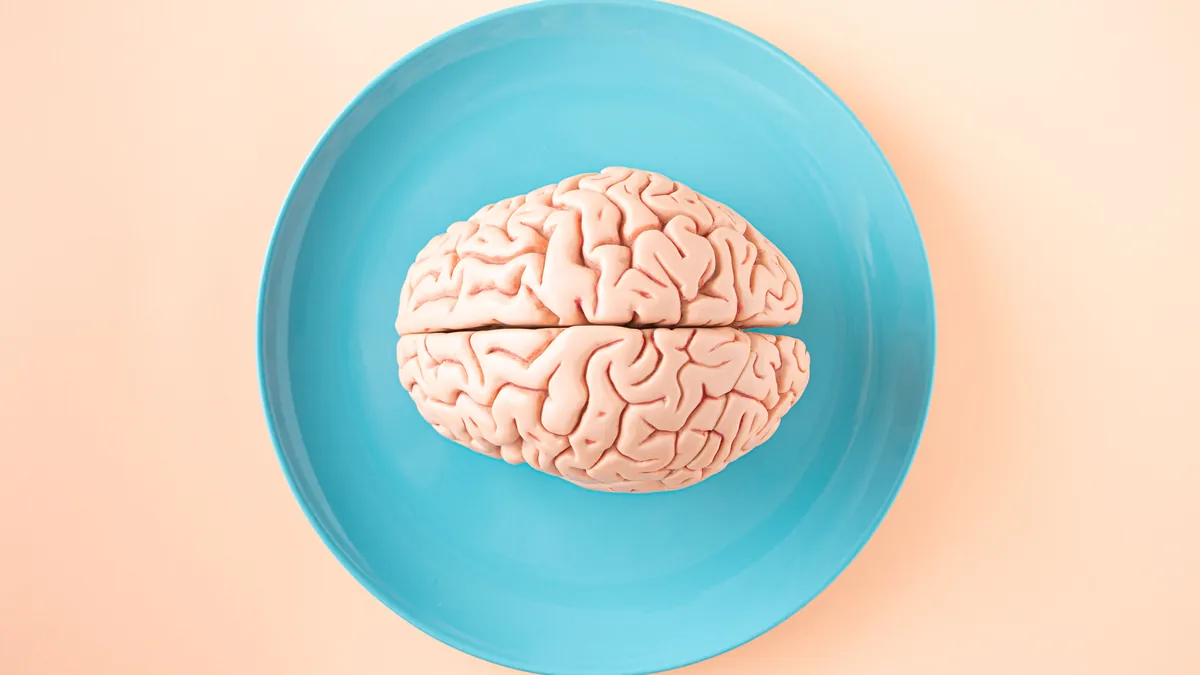
Your brain prefers ketones, the clean-burning fuel your body makes from fat, and falls back on glucose only when ketones run out. In Alzheimer’s disease, the brain loses its grip on glucose years before memory slips. Its ketone uptake mostly holds. That is why researchers call it “type 3 diabetes.”
We have been told a story about the aging brain. Your genes dealt you a hand, the clock runs down, and one day the lights dim. In that story, dementia is something that happens to you. This article is Part 1 of the Starved Brain series from Dr. Gurpreet Singh Padda, MD, MBA, MHP, at Regen.MD. It makes the case that, for most people, this story is wrong at the root. It starts with the basic question almost everyone gets wrong: what does your brain actually run on?
What fuel does your brain prefer?
Ask a hundred people what powers the brain and ninety-nine will say glucose, which is sugar. It is in every textbook drawing. It is also not the brain’s first choice.
When ketones, the clean-burning fuel your body makes from fat, are in the blood, the brain burns them first. Not as a backup. As a preference. Large parts of the brain will run on ketones and fat as long as they are supplied. They fall back on glucose only when ketones run out.
This is not a fringe claim. You can watch it happen. PET scans track fuel uptake, the same way doctors use them to hunt for cancer. Researchers put people into deeper ketosis and measured ketones rising to supply roughly sixty to seventy percent of the brain’s energy. Glucose sat at normal levels the whole time, ready and ignored. The brain had a choice, and it chose fat.
Why would evolution wire your most important organ to prefer a fuel most modern people almost never make? Because for almost all of human history we did make it. Our ancestors ate meat, ran on fat, and went without food at times. They lived in gentle, on-and-off ketosis as a baseline. The brain did not evolve on a river of sugar.
Why is Alzheimer’s called type 3 diabetes?
Here is where it turns urgent. In Alzheimer’s disease, one of the earliest and most steady findings is that the brain’s ability to take up and use glucose falls. It shows up years, sometimes decades, before memory symptoms. Parts of the brain lose the ability to burn their sugar. The dimming is visible on a PET scan before a patient has forgotten a single name.
For a long time we assumed that dimming was the disease: dying cells using less fuel. But a second finding changes everything. Measure ketone uptake in those same Alzheimer’s brains, and it is largely preserved. The cells that can no longer burn sugar can still burn ketones. The engine is not dead. It has been handed a fuel it can no longer process. And the fuel it can process is nowhere in the modern diet.
This is why more and more researchers describe Alzheimer’s disease as “type 3 diabetes”. It is insulin resistance and energy failure confined to the brain. A 2008 review laid out the full case and has since become a landmark. The evidence has kept piling up since.
The fuel was always the point — from birth
The wiring runs deep, and it starts before birth. Metabolic researchers have described pregnancy as “accelerated starvation”. As pregnancy goes on, mothers slip into ketosis faster and easier than anyone else. Those ketones cross the placenta freely. The fast-growing baby brain of the third trimester needs them. It uses them as fuel and as raw material for the fats that build the brain.
It does not stop at birth. Breast milk is deliberately ketogenic. Even with the milk sugar lactose present, breastfed babies run on ketones. Studies comparing breastfed to formula-fed babies find the formula-fed ones make measurably fewer ketones. From its first days, the human brain is built to burn fat and ketones and to be built from fat.
And here is the tell that this is a diet story and not just an aging story. Age-related brain shrinkage has not been shown in wild animals eating their natural diets. Researchers looked for it directly in chimpanzees, our closest relatives. Human brains shrank, as expected. The chimpanzee brains shrank far less, and far later in life.
The honest read on the evidence
Precision is how you know you can trust the rest of this series. So here are the limits of these findings, stated plainly. The authors of that chimpanzee study blamed the human shrinkage mainly on our unusually long lifespan, not directly on diet. That is their honest read, and it is worth honoring. Separately, a 2024 study compared farm pigs with wild boar. It found smaller brains in the grain-fed farm pigs, but the result was not statistically airtight. The pigs bred hardest for muscle actually had larger brains. What that study cleanly proves is not “grain shrinks brains.” It proves the deeper point this series rests on: brain size is not fixed — it responds to environment and nutrition. The brain can change, and diet is one of the hands that shapes it.
What this means for your evaluation
Step back and look again. We see shrinkage on brain scans of older adults and call it “normal age-related atrophy.” But look at what we know. The brain prefers a fuel most modern people never make. The disease process is a brain starving for sugar it can no longer burn. And our closest relatives age with far less of this shrinkage, far later. What if normal aging of the brain is, for many people, decades of quiet fuel starvation etched into an organ?
That is a testable question, not a verdict. At Regen.MD we do not guess about it. We measure your metabolic and fuel status. That shows whether your brain lives in the energy crisis described here. It also shows whether it can be moved toward ketone fuel safely, with every medication you take accounted for. A starving brain may be a fixable brain. The first step is knowing whether yours is starving at all.
For more information, get our free guide to knee pain and treatment options.
Frequently asked questions
Is glucose bad for my brain?
No. Your brain always uses some glucose, and certain cells depend on it. The point is that the brain also runs well on ketones and seems to prefer them. In Alzheimer’s, the glucose-burning machinery fails while the ketone-burning machinery mostly holds. This is about which fuels are on hand, not about calling one fuel evil.
What is “type 3 diabetes”?
Some researchers use this term for Alzheimer’s disease. It describes insulin resistance and energy failure confined to the brain, a brain that cannot properly use glucose for fuel. It is a useful frame backed by a growing body of work. It is not a separate formal diagnosis you will find on a standard lab slip.
Should I start a ketogenic diet to protect my brain?
Do not start a ketogenic or other significant diet without medical supervision, especially if you take medication for diabetes or blood pressure, where the dose may need adjustment. This article is educational. The right first step is evaluation of your actual metabolic status, not a diet copied from a screen. Individual results vary.
To see what a physician-supervised ketogenic plan looks like, read One Lever, Many Diseases: The Regenerative Brain Protocol.
Does a shrinking brain on a scan mean I have dementia?
No. Brain volume changes are one signal among many. A physician must read them alongside your history, exam, and other tests. This series aims to show that brain shrinkage may be changeable. It is not meant to help anyone self-diagnose from a scan report.
For the nutrients that decide whether the brain grows or shrinks, read The Canary: The Nutrients That Decide Whether Your Brain Grows or Shrinks.
Where is Regen.MD located?
Regen.MD is Dr. Padda’s regenerative medicine practice at 4477 Woodson Rd, Suite 103, St. Louis, MO 63134. You can call (314) 295-3000 or text (314) 886-5902.
Part 4 of this series, The Poisoning: How the Modern Plate Sets the Brain on Fire, covers what the modern diet does to the brain.
What causes type 3 diabetes?
Type 3 diabetes means insulin resistance and energy failure confined to the brain. Parts of the brain lose the ability to take up and burn glucose. That dimming shows on a PET scan years, sometimes decades, before memory symptoms. Those same cells can still burn ketones. But ketones are a fuel most modern people almost never make, so the brain is left starving.
Is type 3 diabetes serious?
Yes. A growing number of researchers use this name for Alzheimer’s disease. In it, the brain’s ability to use glucose falls before a patient has forgotten a single name. The hopeful part: ketone uptake in those same brains mostly holds, so the engine is not dead. A starving brain may be a fixable brain. The first step is measuring whether yours is starving.
Key takeaways
- The brain runs well on ketones and seems to prefer them. In Alzheimer’s, glucose uptake fails years before symptoms while ketone uptake mostly holds.
- This pattern is why some researchers call Alzheimer’s “type 3 diabetes”, an energy crisis confined to the brain.
- The proof that diet shapes brain size is real but honestly limited. What is well supported is that brain size can change and responds to nutrition.
- The step to take is measuring your own metabolic and fuel status, not starting a diet on your own. That is because a starving brain may be a fixable one.
This article is educational and is not a substitute for evaluation, diagnosis, or treatment by a physician. Individual results vary. Do not start, stop, or change any medication or diet without consulting your physician — this is especially important if you take medication for diabetes or blood pressure. To have your metabolic and cognitive terrain evaluated, apply for a Clinical Evaluation at Regen.MD or call (314) 295-3000 / text (314) 886-5902.
References
- de la Monte SM, Wands JR. Alzheimer’s disease is type 3 diabetes — evidence reviewed. J Diabetes Sci Technol. 2008;2(6):1101-1113.
- Sherwood CC, Gordon AD, Allen JS, et al. Aging of the cerebral cortex differs between humans and chimpanzees. Proc Natl Acad Sci USA. 2011;108(32):13029-13034.
- Cucchi T, Neaux D, Féral L, et al. How domestication, feralization and experience-dependent plasticity affect brain size variation in Sus scrofa. R Soc Open Sci. 2024;11(9):240951.
Find out what your brain’s terrain is actually doing
Regen.MD begins with a physician-led Clinical Evaluation — a review of your history, labs, and metabolic data, and a written terrain roadmap for your brain and body. Evaluation is contingent upon review of your data.
Questions? Call or text us.